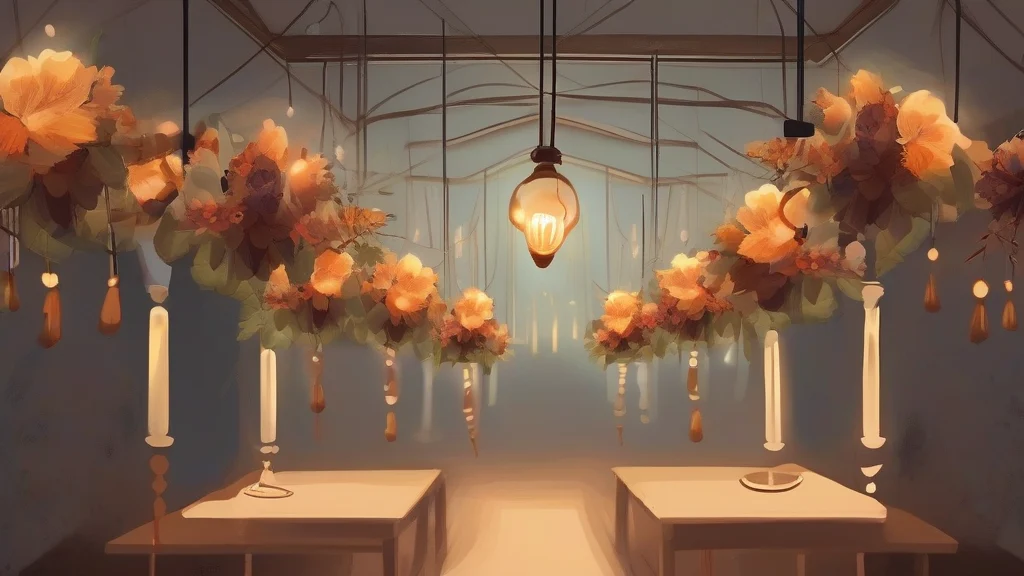
What does festoon mean?
A festoon is a garland or chain of flowers, leaves, ribbons, paper, or lights suspended in a curve between two fixed points, and the word also serves as a verb meaning to decorate a place with such hangings. Festoons appear wherever celebration calls for ornament: weddings, festivals, theatres, streets at Christmas, and classical architecture, where carved stone swags have framed doorways since antiquity. In modern usage the verb dominates, most often in the passive construction "festooned with" — streets festooned with flags, balconies festooned with bunting. Figuratively, the verb can describe anything that drapes abundantly over something, as in a room festooned with cobwebs. The word carries warm, festive connotations and belongs to a slightly elevated register that nonetheless appears freely in journalism and literature. Derived from Latin festa, meaning feasts, it is etymologically a cousin of festival and fiesta, making it quite literally a decoration born of celebration.
A chain or garland of flowers, foliage, ribbons, or other material, hung in a curve between two points as a decoration.
"Festoons of ivy and roses trailed along the banquet table."
In architecture, "festoon" also names the conventional carved motif of draped fruit, flowers, and leaves.
To adorn a place or thing with festoons or other hanging decorations; figuratively, to lie or hang over something in abundance like a garland.
"Villagers festooned the square with lanterns ahead of the summer fair."
Most frequently used in the passive form "be festooned with."
Standard regular plural; commonly used when referring to multiple garlands or strands of decoration.
"Festoons of coloured paper swung gently above the dance floor."
Every Christmas string of lights across your street is doing exactly what Italian banquet decorators were doing centuries ago — because "festoon" literally descends from the Latin word for "feast."
Reviewed by Deb Chak, Editor. AI-assisted content curated by RJS Tech Solutions LLP.
Etymology of festoon
Festoon entered English in the early 17th century from the French "feston," which derived from the Italian "festone," ultimately rooted in the Latin "festa," meaning feasts or festivals. This makes the word a direct relative of "feast," "festival," and "fiesta," all tracing back to the same Latin source. Its earliest English uses referred specifically to the carved or drawn garlands of fruit, flowers, and leaves that adorned classical architecture, before broadening to cover any hanging decorative garland and, later, the verb sense of adorning with such decorations.
Related word forms
How festoon is actually used
The verb is more common than the noun in everyday modern usage and typically appears in the passive form "be festooned with." The word carries festive, celebratory connotations and sits comfortably in both journalistic and literary registers; it can sound slightly ornate in casual speech, which suits its decorative subject matter.
Easily confused with festoon
Festoon means to decorate with hanging garlands, while fester means a wound or problem to become infected or worsen over time.