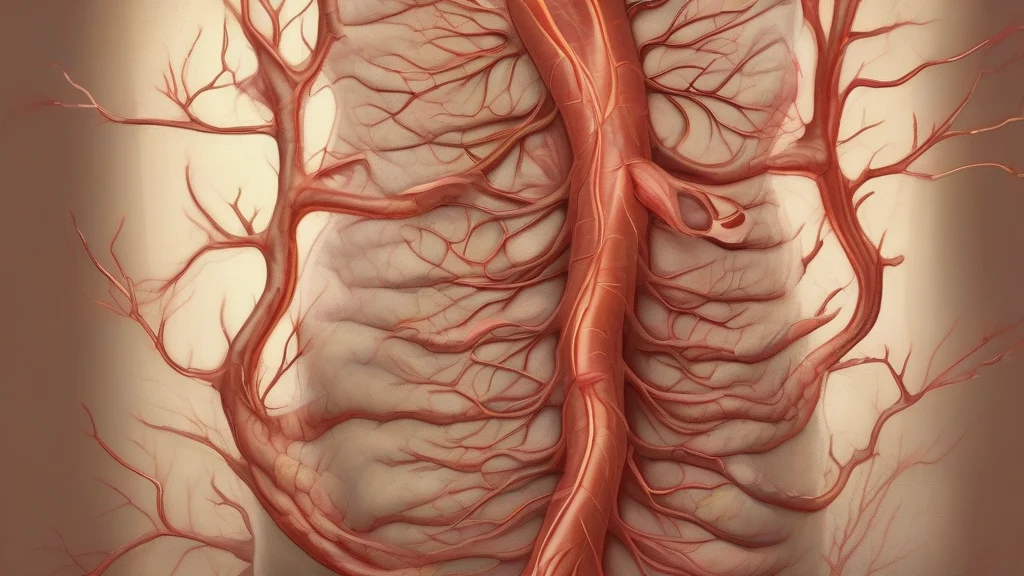
What does fibrovascular mean?
Fibrovascular is an adjective used in medicine, pathology, and botany to describe structures made up of, or associated with, both fibrous connective tissue and blood vessels. In the body, fibrovascular tissue commonly forms supporting frameworks around organs, supplies blood to growing masses such as tumors, and appears in descriptions of membranes, bundles, and stroma. In plants, fibrovascular bundles — the familiar 'veins' of leaves and stems — combine conducting vessels with strengthening fibers, serving as the plant's transport and support system. The word is purely technical in register: it belongs to surgical reports, histology textbooks, and botanical descriptions rather than everyday speech, and it is most often found attributively in set phrases like 'fibrovascular bundle' or 'fibrovascular core'. Its value lies in precision, letting clinicians and scientists name, in a single term, the intimate pairing of structural fiber and blood supply that defines many tissues.
adjectiveComposed of, containing, or relating to both fibrous tissue and blood vessels, especially in anatomical or botanical structures such as the vascular bundles of plants.
- Relating to or composed of fibrous tissue and blood vessels together, especially describing anatomical structures or plant vascular bundles.
"The surgeon noted a dense fibrovascular bundle supplying blood to the tumor."
"Under the microscope, the biopsy revealed abundant fibrovascular tissue surrounding the ducts."
"In palms and other monocots, fibrovascular bundles are scattered throughout the stem rather than arranged in a ring."
Every leaf you've ever seen is threaded with fibrovascular bundles — the same plumbing-like tissue that surgeons navigate inside the human body.
Reviewed by Deb Chak, Editor. AI-assisted content curated by RJS Tech Solutions LLP.
Etymology of fibrovascular
Fibrovascular is a compound of two Latin-derived elements: 'fibro-', from Latin 'fibra', meaning fiber, and 'vascular', from Latin 'vasculum', a small vessel, itself a diminutive of 'vas'. The word was formed on the neo-Latin pattern typical of scientific terminology coined in the eighteenth and nineteenth centuries, when anatomists and botanists combined classical roots to label newly described structures. It shares those roots with words such as 'fiber', 'fibril', 'vessel', and 'vascularize', all tracing back to the same Latin stock.
How fibrovascular is actually used
Fibrovascular is a technical term used almost exclusively in medical, pathological, and botanical contexts; it rarely appears in general conversation or informal writing. It is typically used attributively (e.g., 'fibrovascular bundle', 'fibrovascular tissue') rather than predicatively.
Easily confused with fibrovascular
Avascular means lacking blood vessels entirely, whereas fibrovascular describes tissue that contains both fibrous tissue and blood vessels.
Neurovascular refers to the combination of nerves and blood vessels, while fibrovascular refers to the combination of fibrous tissue and blood vessels.