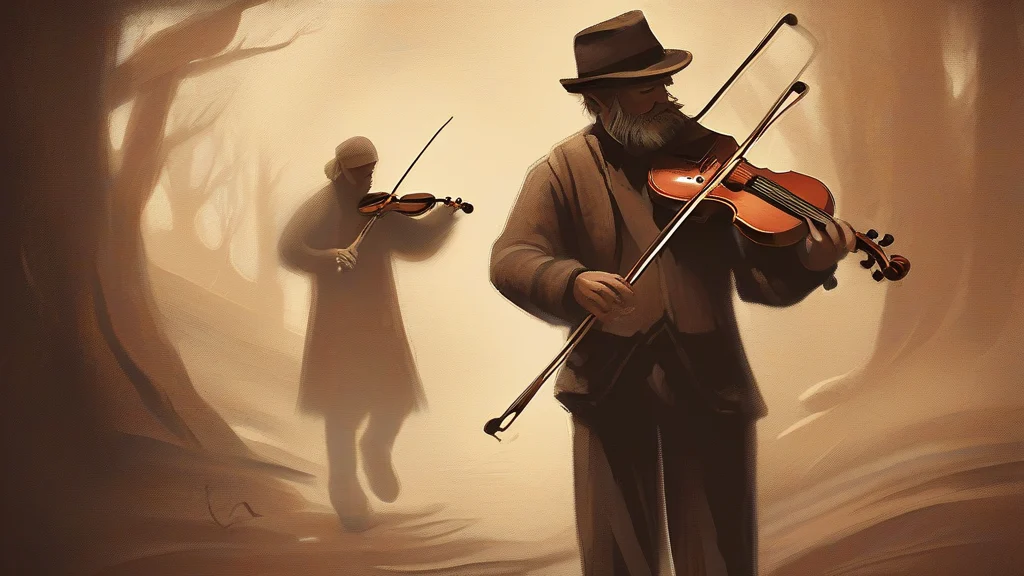
What does fiddler mean?
A fiddler is, at its heart, a musician — specifically one who plays the fiddle, an informal name for the violin. While 'violinist' suggests classical training and concert halls, 'fiddler' evokes folk tunes, barn dances, sea shanties, and pub sessions; the word carries a warm, earthy connotation rooted in vernacular musical traditions of Britain, Ireland, and North America. In British slang, however, the word has a second life: a fiddler can mean a cheat or swindler, someone who manipulates accounts or bends rules for petty gain. It can further describe a person who fidgets or tinkers restlessly with objects. This range — from artist to rogue to fidgeter — makes 'fiddler' a word whose meaning depends heavily on context. Its most famous cultural appearance may be 'Fiddler on the Roof', where the image of a balancing fiddler symbolizes fragile tradition. For anyone writing about music, folk culture, or colloquial British English, it remains a vivid and useful term.
nounA person who plays the fiddle, especially a professional or skilled violinist, often in folk, traditional, or informal musical settings; also, in British slang, someone who cheats or swindles, or who fusses idly with something.
- A person who plays the fiddle (violin), especially in folk, country, or traditional music.
- (Chiefly British, informal) A person who cheats, swindles, or acts dishonestly in small ways.
- (Informal) A person who tinkers or fidgets with something in a restless or aimless way.
"The village dance came alive as soon as the old fiddler struck up his first tune."
"A lone fiddler entertained passengers on the ferry with lively jigs."
"He was known around the market as a bit of a fiddler who'd shave corners wherever he could."
Standard pluralization; used when referring to multiple players of the fiddle.
"Three fiddlers took turns leading the ceilidh through the night."
In folk tradition, the difference between a fiddler and a violinist isn't the instrument — it's the attitude: same strings, entirely different soul.
Reviewed by Deb Chak, Editor. AI-assisted content curated by RJS Tech Solutions LLP.
Etymology of fiddler
Fiddler derives from 'fiddle', the older English name for a bowed string instrument, which itself descends from medieval Latin 'vitula' (a stringed instrument), via Old French 'viole' and related Germanic forms — the same root that gave us 'violin'. The agent noun 'fiddler' emerged in Middle English to denote one who plays the instrument, appearing by at least the late medieval period. Its figurative senses, including the British slang for a cheat, developed later from the verb 'fiddle', which acquired meanings of tampering or swindling.
Related word forms
How fiddler is actually used
The primary sense is neutral and widely used across English-speaking regions. In British informal usage, 'fiddler' can carry negative connotations of dishonesty or petty cheating. The term also appears in the well-known phrase 'fiddler on the roof', popularized by the musical of that name.
Easily confused with fiddler
A violinist is a formally trained player of the violin, typically in classical contexts, while a fiddler plays folk or traditional music and is often self-taught.
Fiddly describes something awkward or requiring fussy manual dexterity, whereas fiddler refers to a person who plays the fiddle (or, in slang, cheats).