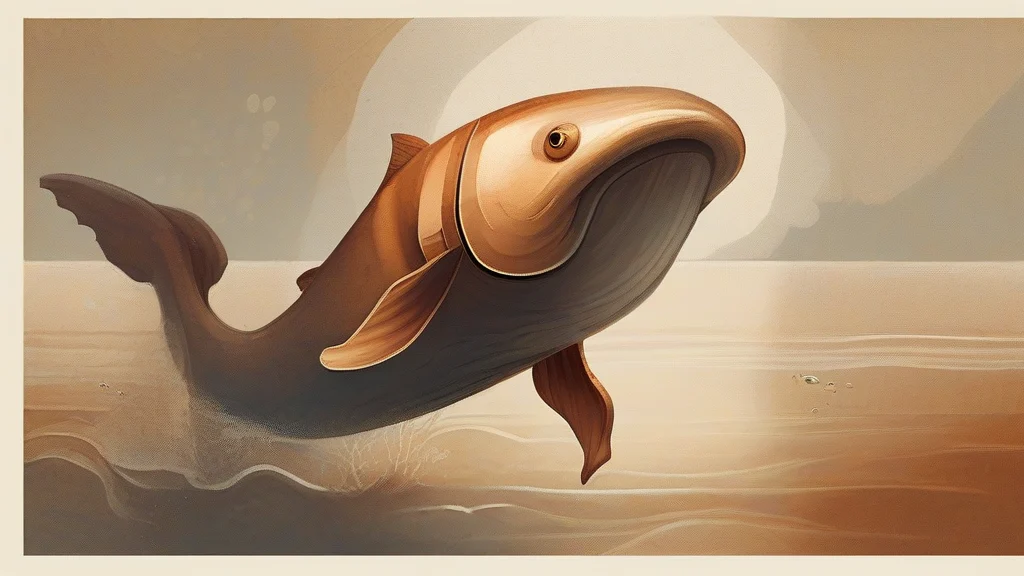
What does fin mean?
A fin is a broad, flat structure extending from the body of fish, whales, sharks, and other aquatic animals. Fins serve several purposes: they stabilize the animal in the water, help it steer and balance, and in some species provide propulsion. Humans borrowed the idea for their own gear — swimmers and divers strap rubber fins to their feet — and engineers added fins to surfboards, rockets, submarines, and even cars, where tail fins defined 1950s American automotive style. In informal American English, a 'fin' once meant a five-dollar bill, though this usage has faded. Common phrases include 'dorsal fin,' 'tail fin,' and 'shark fin soup,' a dish whose association with overfishing has made the word prominent in conservation discussions. Compact and versatile, 'fin' bridges biology, sport, engineering, and slang, making it a small word with surprisingly wide reach.
A flattened limb or appendage of a fish or other aquatic animal, used for propulsion, steering, or balance; by extension, any thin vertical or horizontal stabilizing surface on a vehicle, board, or machine.
"The grouper fluttered its pectoral fins as it hovered near the reef."
Specific fins have distinct names — dorsal, pectoral, pelvic, anal, and caudal (tail) fins in fish.
To propel or steer oneself through water by means of fins; also (of sharks) to break the surface with the dorsal fin while swimming.
"We watched the dolphin fin gracefully alongside the boat."
Chiefly used in diving, swimming, and marine-watching contexts.
(Informal, chiefly US) A five-dollar bill.
"He slipped the waiter a fin along with the tip."
Regular plural; standard in all varieties of English.
"Tropical fish display an astonishing variety of brightly colored fins."
A shark can't swim without its fins — but neither could a 1950s Cadillac, whose tail fins were borrowed straight from the F-86 fighter jet.
Reviewed by Deb Chak, Editor. AI-assisted content curated by RJS Tech Solutions LLP.
Etymology of fin
'Fin' comes from the Old English 'finn', meaning the fin of a fish, and shares Germanic roots with Dutch 'vin' and German 'Finne'. Some scholars have suggested a distant connection to the Latin 'pinna', meaning feather or wing — the same root behind English 'pinnate' — though this link remains uncertain. The word has retained its core aquatic meaning across more than a thousand years of English, later extending metaphorically to any thin stabilizing projection.
Related word forms
How fin is actually used
As a noun, 'fin' is neutral in register. The slang sense for a five-dollar note is informal and largely American, now somewhat dated but still understood. As a verb, 'to fin' is used mainly in diving and swimming contexts.
Easily confused with fin
'Fine' means satisfactory, thin, or a penalty payment, whereas 'fin' is the appendage of an aquatic animal or similar stabilizing projection.