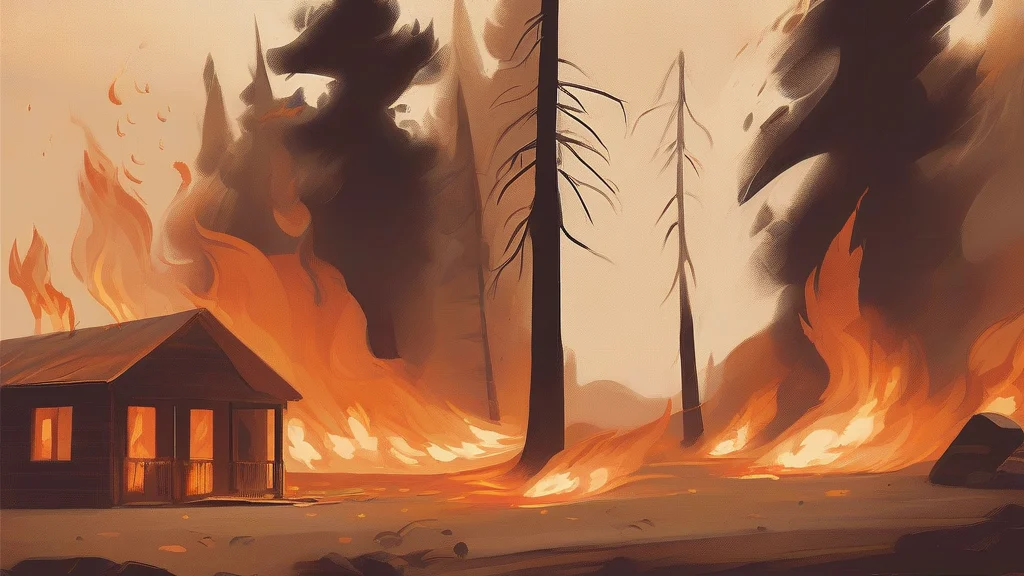
What does fire mean?
Fire is the process of combustion, in which a material combines rapidly with oxygen to release heat, light, and flame. It is among humanity's oldest and most consequential tools, essential for warmth, cooking, metallurgy, and industry, yet also a destructive force when uncontrolled, as in wildfires and house fires. Beyond its literal sense, fire appears throughout English in vivid figurative uses: a passionate person is said to have fire, brilliant sunsets can glow like fire, and phrases such as 'catch fire,' 'on fire,' and 'open fire' extend its reach into everyday speech. The word also names the discharge of firearms, linking it to both violence and ceremony, as in a salute fired in honor. Few words combine such practical importance, physical drama, and expressive range.
Combustion producing flame, heat, and light; an instance of destructive burning; intense passion or brilliance; gunfire.
"Smoke rose from the fire in the hearth."
Countable when referring to individual fires ('a fire broke out'), uncountable when referring to the phenomenon generally.
To discharge a weapon; to dismiss someone from employment; to ignite or set alight; to expose clay to heat in a kiln to harden it.
"The company decided to fire two senior managers last quarter."
Used when referring to multiple instances of fire, especially separate incidents such as wildfires or structural fires.
"Several fires broke out across the state during the dry season."
Fire is one of the few English words whose ancient root — reaching back thousands of years to Proto-Indo-European *per/*pur — survives in everything from funeral pyres to the Greek myths of the gods' empyrean home.
Reviewed by Deb Chak, Editor. AI-assisted content curated by RJS Tech Solutions LLP.
Etymology of fire
The word fire descends from Old English fyr, from Proto-Germanic *furī, ultimately from the same Proto-Indo-European root (*peh₂wr̥) that gave Greek pyr. This ancient shared origin links English fire with Greek-derived words such as pyre and pyromania, and with the Latin purus via related roots. The spelling and pronunciation were established early, and fire has been continuous in English since the earliest records.
Related word forms
How fire is actually used
Fire is neutral in register and appears across all varieties of English. As a verb it carries distinct senses — dismissing an employee ('he was fired') and discharging a weapon ('fire the cannon') — which are common enough to matter but belong to the verb form. In figurative use, fire connotes intensity of emotion or brilliance, often positively but sometimes dangerously.
Easily confused with fire
A pyre is specifically a structured pile of wood for burning a body in a funeral rite, whereas fire refers to combustion generally.