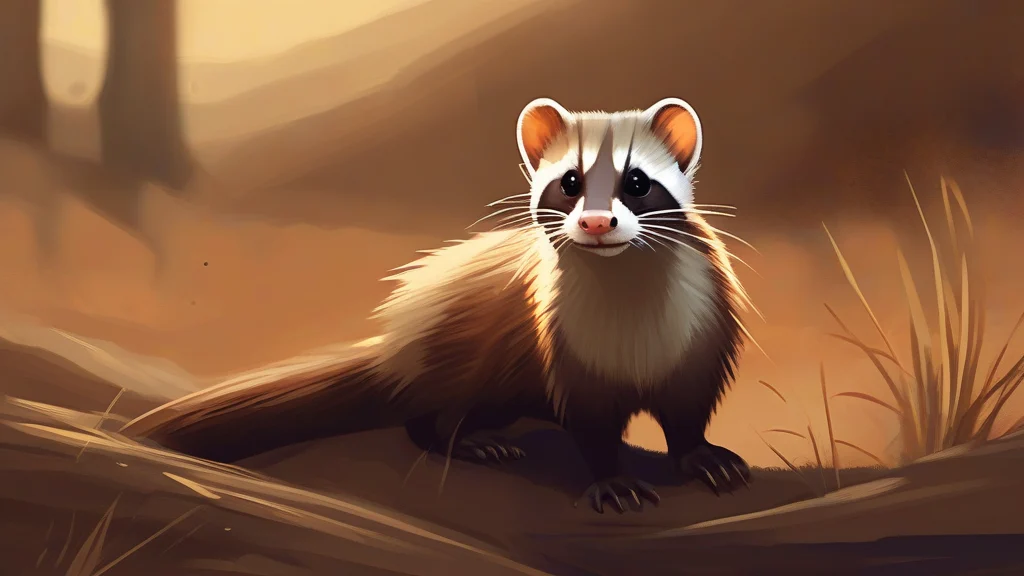
What does fitchet mean?
The fitchet is an old British name for the European polecat (Mustela putorius), a slender, mostly nocturnal member of the weasel family found across woodland, farmland, and hedgerows. Polecats are solitary hunters that prey on rabbits, rats, and ground-nesting birds, and they are notorious for the pungent musk they release when threatened — a trait that earned them rustic alternative names such as 'foumart' ('foul marten'). The term 'fitchet' derives through Old French from names for the animal, and its shorter form, 'fitch', long served as a fur-trade label for the polecat's dark pelt. Though the word has all but vanished from everyday English, replaced by 'polecat', it lingers in historical natural histories, gamekeeping records, and regional tradition, offering a glimpse of how rural Britain named the animals that shared its countryside centuries ago.
nounA fitchet is the European polecat (Mustela putorius), a small carnivorous mammal of the weasel family, now largely an archaic or regional country name for the animal.
- The European polecat (Mustela putorius), a wild mustelid known for its dark fur and strong scent.
"The gamekeeper spotted a fitchet slipping along the hedgerow at dusk."
"Pheasant eggs vanished from the nesting cover, and the keeper rightly blamed a fitchet."
"In older natural-history writing, the fitchet and the foumart are simply regional names for the polecat."
Standard pluralization; rarely encountered since the word itself is archaic.
"Keepers once trapped fitchets to protect the game birds on the estate."
Long before 'polecat' became standard, British country folk called this musky hunter a 'fitchet' — and its dark pelt, sold as 'fitch', once trimmed the coats of Europe.
Reviewed by Deb Chak, Editor. AI-assisted content curated by RJS Tech Solutions LLP.
Etymology of fitchet
Fitchet entered English via Old French names for the polecat, appearing in medieval and early-modern usage alongside the variant 'fitchew'; the short form 'fitch' came to denote the animal's fur in the fur trade. The exact ultimate origin of the French name is debated, so it is best described generally as a borrowing tied to Continental names for the polecat rather than traced with false precision. Related rustic English names include 'fitchew' and 'foumart', the latter blending 'foul' and 'marten' in reference to the animal's smell.
How fitchet is actually used
The word is archaic or dialectal in modern English; contemporary wildlife writing uses 'polecat'. It survives mainly in older rural speech, hunting lore, and historical texts.
Easily confused with fitchet
A ferret is the domesticated form descended from the polecat, whereas the fitchet refers to the wild polecat itself.