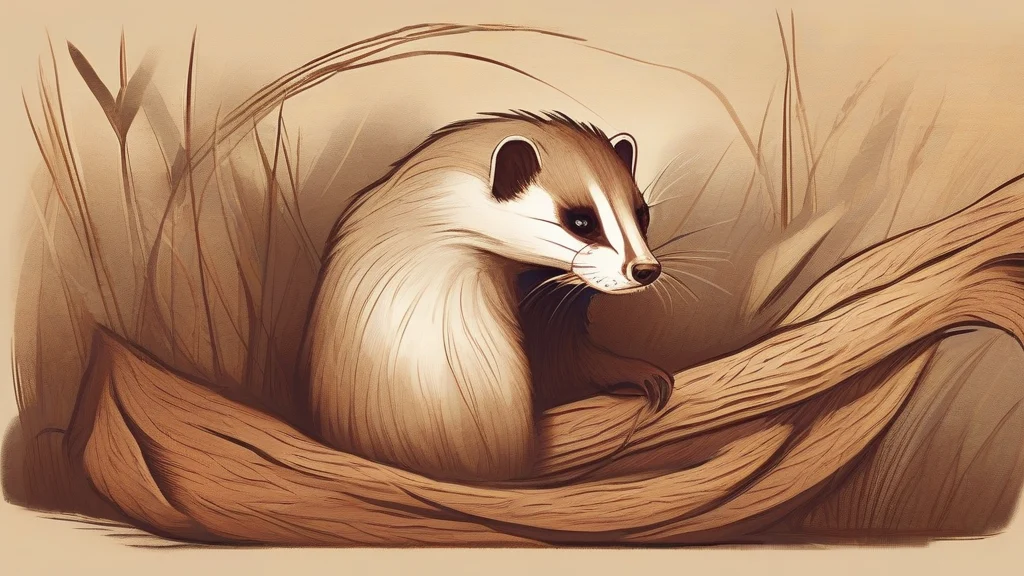
What does fitchew mean?
Fitchew is an old English name for the polecat, Mustela putorius, a small, fierce member of the weasel family once common across the British countryside. Rural communities knew the animal well — and resented it — because polecats raided poultry coops and henhouses, and because they defend themselves with a powerful musky discharge. That unpleasant scent shaped the word's cultural afterlife: in Elizabethan and Jacobean writing, 'fitchew' could be hurled figuratively at people, implying someone sly, filthy, or morally stinking. The name survives chiefly in older texts, folklore, and historical accounts of British wildlife, alongside close variants such as 'fitchet' and 'foulmart'. Today the living animal is simply called a polecat, and its populations, once persecuted nearly to extinction in Britain, have partially recovered — making 'fitchew' a small window into how country names, animal lore, and human prejudice intertwined in earlier centuries.
The polecat (Mustela putorius); formerly a widespread rural English name for the animal.
"In old farm records, the fitchew appears among the vermin bounty payments alongside foxes and rats."
Obsolete as a common name; found mainly in historical, literary, and folkloric contexts.
Figuratively, a person regarded as sly, foul-smelling, or contemptible.
"The pamphleteer denounced his rival as a fitchew of the first order."
The plural simply adds -s; as an obsolete vernacular term, historical sources vary and may use unmarked plurals or variants such as 'fitchets'.
"Bounty lists from the parish record several fitchews killed near the warren each winter."
'Fitchew' is what Shakespeare's England called the polecat — a word so tied to the animal's musky repute that 'fitchew' became shorthand for a foul-smelling or disreputable creature.
Reviewed by Deb Chak, Editor. AI-assisted content curated by RJS Tech Solutions LLP.
Etymology of fitchew
The precise linguistic origin of 'fitchew' is not firmly established, and dictionaries treat it as a vernacular name of somewhat obscure derivation that circulated in Britain from medieval or early modern times alongside related variants such as 'fitch', 'fitchet', and 'foulmart'. All of these names refer to the polecat, and their shared use suggests a family of folk terms rather than a single formal lineage. The word appears in English natural history and general literature into the seventeenth century before falling out of everyday use as 'polecat' became the standard name.
Related word forms
How fitchew is actually used
'Fitchew' is an obsolete vernacular term, now encountered only in older literature, folklore references, and historical natural-history writing; modern sources say 'polecat'. Its figurative use as a slur against people appears in early modern writing but is no longer current.
Easily confused with fitchew
The ferret is the domesticated form descended from the polecat, whereas 'fitchew' was an old vernacular name for the wild polecat itself.
'Fitchet' and 'fitchew' are closely related historical variants naming the same animal, the polecat, rather than different creatures.