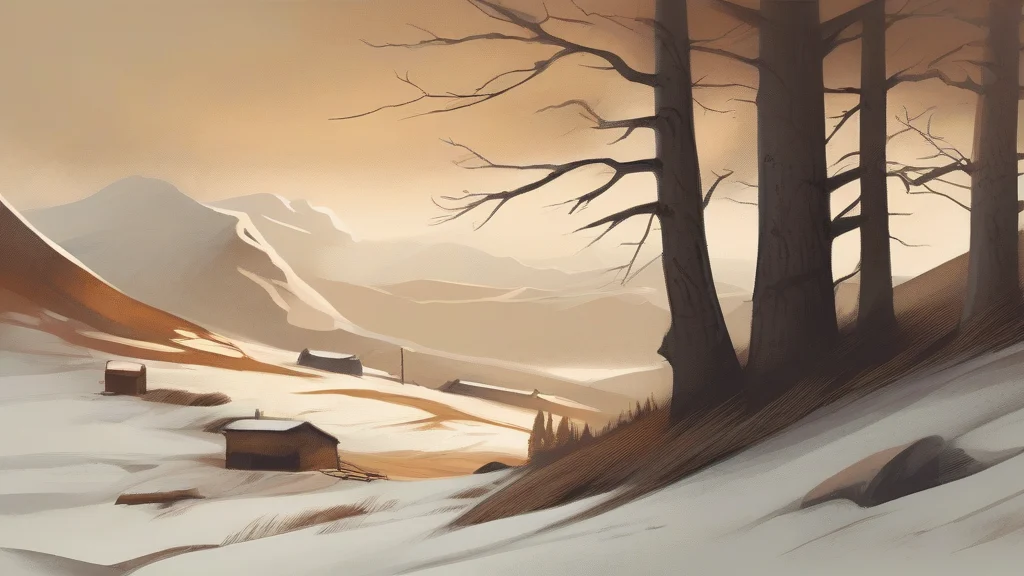
What does fjeld mean?
Fjeld is a noun denoting a high, barren, treeless plateau, particularly the extensive upland surfaces that dominate Norway and neighbouring parts of Scandinavia. Borrowed directly from the Norwegian word of the same name, it describes terrain shaped by ice and weather: broad, rolling expanses above the forest line, often covered with snow well into summer and supporting little vegetation beyond lichen, moss, and hardy shrubs. In practice, the term appears mainly in geography, travel writing, and ecological studies of northern Europe, where it distinguishes these elevated plateaus from individual peaks or lowland plains. Reindeer herding, for example, is closely tied to seasonal movement between forests and fjeld pastures. For English readers, fjeld offers a precise and evocative label for a distinctive northern landscape — one whose linguistic relative, 'fell', survives in the hill country of northern England.
nounA barren, elevated plateau or upland region, especially one characteristic of Norway and other parts of Scandinavia, typically bare of trees and often snow-covered for much of the year.
- A barren, treeless elevated plateau or upland, especially in Scandinavia.
"The reindeer herders moved their animals across the frozen fjeld as winter closed in."
"After hours of climbing, we emerged onto the open fjeld, where nothing broke the horizon but snow and sky."
"In Lapland, reindeer migrate seasonally between the sheltered forests below and the exposed lichen pastures of the fjeld."
The plural 'fjelds' exists but is uncommon; the singular is frequently treated as a collective term for such terrain.
"The map showed a succession of fjelds stretching toward the distant coast."
The word 'fjeld' comes straight from Norwegian, where it names the vast treeless plateaus that cover much of the country — and its cousin 'fell', used for England's Lake District hills, shares the very same Norse ancestry.
Reviewed by Deb Chak, Editor. AI-assisted content curated by RJS Tech Solutions LLP.
Etymology of fjeld
Fjeld derives from the Norwegian word 'fjell' (in Danish-derived forms 'fjeld'), meaning mountain or upland plateau, which traces back to Old Norse 'fjall'. The same Norse root gave rise to the English term 'fell', used for hills and mountains in northern England, making the two words true cousins from a shared Scandinavian source. The word entered English vocabulary largely through nineteenth-century geographical and travel literature describing Scandinavian landscapes.
How fjeld is actually used
Fjeld is primarily a geographical term borrowed from Norwegian and is most often encountered in writing about Scandinavian or Arctic landscapes, including travel, geography, and ecology. It carries no figurative or everyday usage in general English and may be unfamiliar to many readers, so it is best used when precision about Nordic terrain matters.
Easily confused with fjeld
A 'field' is an open area of land, typically farmland or grassland at low elevation, whereas a 'fjeld' is specifically a high, barren Scandinavian plateau.
A 'fell' refers to a hill or mountain, especially in northern England, while a 'fjeld' denotes a broad elevated plateau rather than a single peak.