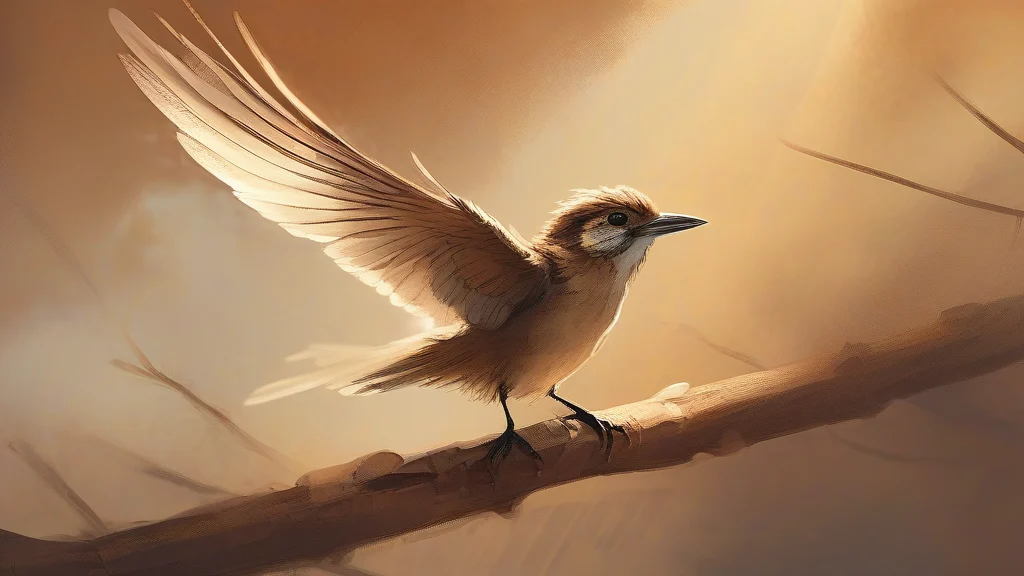
What does fledge mean?
To fledge is, in its strictest sense, what a young bird does when it grows the wing and tail feathers that make flight possible — usually followed within days by its first departure from the nest. The word derives from an Old English term meaning 'able to fly,' and it remains central to ornithological language: conservationists report how many chicks a pair of eagles or peregrines has fledged each season, making the verb a standard measure of breeding success. By extension, to fledge can mean to raise a young bird until it reaches that stage. Though the verb itself stays close to its biological roots, its derivatives have flown further: a 'fledgling' describes any novice — a fledgling writer, a fledgling company — while 'full-fledged' means fully developed or officially qualified. This small family of words captures one of nature's most vivid milestones and lends it, metaphorically, to every human undertaking that begins in a nest of sorts and ends in first flight.
verbOf a young bird, to develop the wing and tail feathers needed for flight; by extension, to bring up or care for a young bird until it reaches this stage.
- (of a young bird) to acquire the feathers necessary for flight, typically leaving the nest around this time
- to rear or bring up a young bird until it is capable of flight
"The nestlings will fledge in about two weeks, when their flight feathers are fully grown."
"The swallows fledged early this year, taking their first flights above the barn."
"A pair of peregrines successfully fledged three chicks from the cathedral tower."
Before 'fledge' named a milestone in a bird's life, it was an adjective in Old English meaning simply 'feathered enough to fly' — humans have been watching for that moment for over a thousand years.
Reviewed by Deb Chak, Editor. AI-assisted content curated by RJS Tech Solutions LLP.
Etymology of fledge
Fledge traces back to Old English 'flycge', an adjective meaning 'having feathers, able to fly', itself formed from the Germanic root that also gave us the verb 'fly' and the noun 'flight'. Originally describing birds rather than naming an action, it shifted into a verb in Middle English, first meaning 'to furnish with feathers'. The extended sense of rearing young birds to independence developed later, and the word's relatives include 'fledgling', which emerged as a term for a bird young enough to have just fledged.
Related word forms
How fledge is actually used
Fledge is chiefly used by ornithologists, birders, and wildlife writers, though the related adjective 'full-fledged' and noun 'fledgling' have passed into general usage for people or ventures newly qualified or established. The verb itself carries no strong connotation, but its derivatives are often applied metaphorically to careers, companies, and projects.