What does flugelhorn mean?
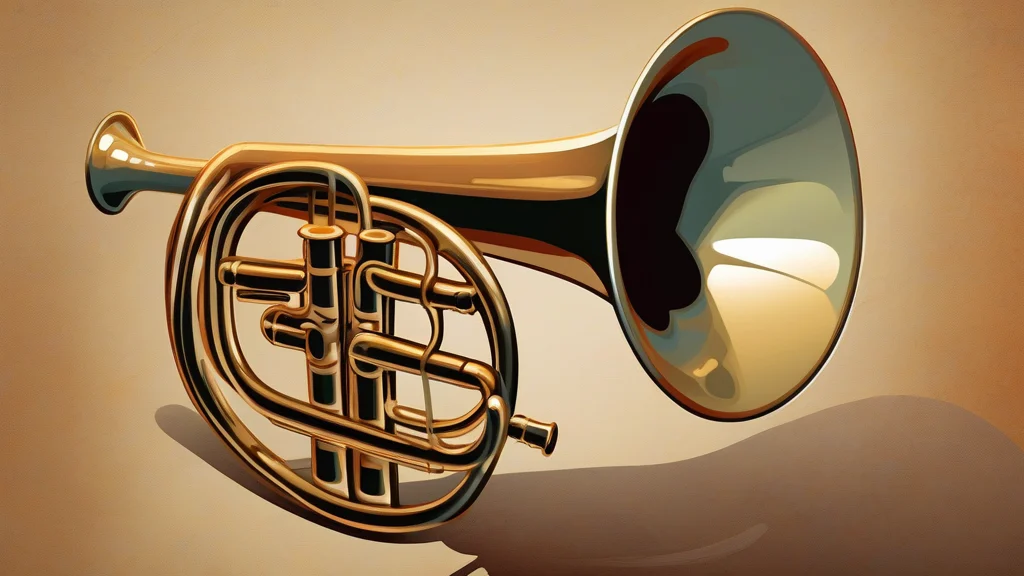
The flugelhorn is a brass wind instrument belonging to the trumpet family, pitched in B♭ and fitted with three piston valves. Although it looks broadly similar to a trumpet, its bore is far wider and largely conical, and its mouthpiece is deeper, producing a distinctly darker, rounder, and more mellow tone. This warmth has made it a favourite for lyrical solos in jazz, where trumpeters often double on flugelhorn for ballads, and it holds a prominent place in British brass bands, typically leading the melody line. The name derives from the German Flügelhorn, literally 'wing horn', reflecting the instrument's origins in signal horns used on the flank — the Flügel — of military formations. For listeners, the flugelhorn is the voice of the brass family at its smoothest and most intimate, trading brilliance for a rich, velvety character found on countless recordings.
nounA flugelhorn is a brass wind instrument resembling a trumpet but with a wider, more conical bore and a deeper cup-shaped mouthpiece, giving it a noticeably darker, mellower tone. It is pitched in B♭, uses three piston valves, and is written in the treble clef.
- A B♭ brass instrument of the trumpet family with a wide conical bore and cup mouthpiece, valued for its warm, mellow tone, especially in jazz, brass bands, and ballads.
"The arranger gave the ballad's lingering melody to the flugelhorn, whose warm tone floated above the strings."
"Art Farmer traded his trumpet for a flugelhorn whenever the set turned to slow, lyrical numbers."
"In a British brass band, the flugelhorn sits at the front, carrying delicate solos that no other instrument can match for warmth."
Standard plural; occasionally written 'flugelhorn' unchanged in informal musical contexts, but the plural form is regular and expected.
"The section was reinforced by two flugelhorns for the finale."
Its very name comes from the German word for 'wing' — because this mellow horn once sounded signals from the flank, or wing, of military formations.
Reviewed by Deb Chak, Editor. AI-assisted content curated by RJS Tech Solutions LLP.
Etymology of flugelhorn
The flugelhorn comes from German, where it is called Flügelhorn, meaning 'wing horn'. The name refers to the Flügel — the 'wing' or flank of a military formation — since early versions of the instrument developed from semicircular signal horns (such as the Klappenflügelhorn) blown by troops posted on the army's wings. The instrument evolved during the nineteenth century alongside other valved brass instruments, adopting piston valves to become fully chromatic, and spread into military bands across Europe. Its German root Flügel ('wing') traces back through Germanic forms related to the English word 'wing' itself, making 'wing' a genuine linguistic cousin of the instrument's name.
How flugelhorn is actually used
The word is almost always encountered as 'flugelhorn' in American usage, though the older spelling 'fluegelhorn' (preserving the German umlaut form Flügelhorn) still appears in British and classical sources. The instrument carries connotations of warmth, intimacy, and lyricism — writers and reviewers frequently contrast it with the trumpet's brilliance — and it is strongly associated with jazz ballad playing and British brass-band tradition. It is a specialist term, most familiar to musicians and listeners rather than the general public.
Easily confused with flugelhorn
The cornet is a closely related B♭ brass instrument, but its bore is mostly conical yet narrower than the flugelhorn's, giving it a brighter tone and a more compact shape.
The trumpet has a predominantly cylindrical bore and a brilliant, piercing tone, whereas the flugelhorn's wide conical bore produces a dark, rounded sound.