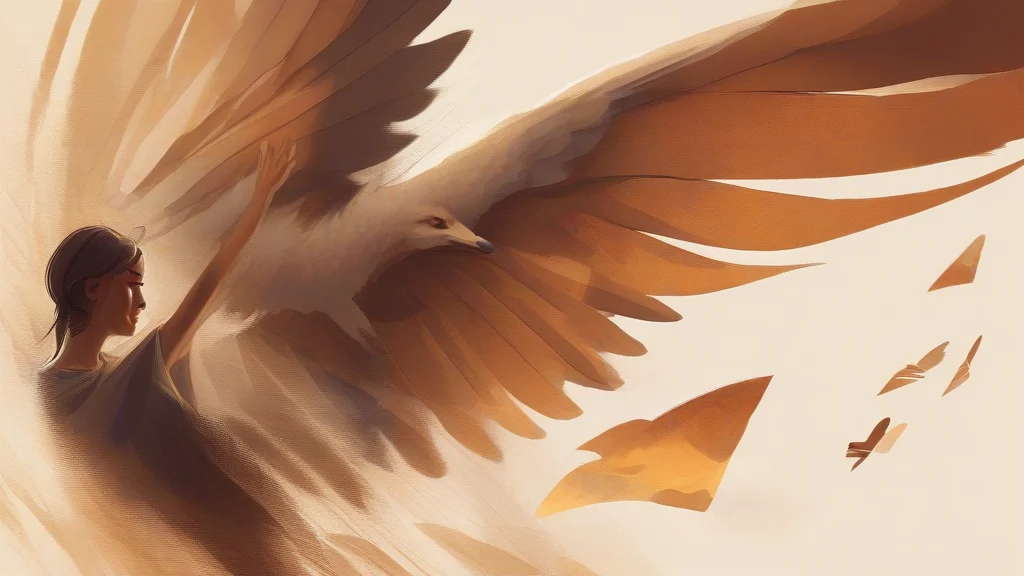
What does flutter mean?
Flutter describes motion that is quick, light, and irregular — the beating of a moth's wings, the rippling of a flag in the wind, the restless trembling of paper caught in a draught. As a verb it captures this kind of movement, and as a noun it names both such motion and a related human experience: a sudden surge of nervous excitement or agitation, so that people speak of their heart fluttering or of being 'in a flutter' when flustered or romantically stirred. The word carries gentle, mostly benign connotations — associated with butterflies, curtains, eyelashes, and first loves rather than with violence or urgency. It also has a precise technical life in aerospace engineering, where 'flutter' names a potentially destructive self-sustaining vibration in aircraft structures. Rooted in Old English words for tossing lightly on air or water, flutter remains a versatile, evocative term linking the physical and the emotional: things that waver, and hearts that do the same.
To move or fly with quick, light, irregular movements, as wings beating or a light object trembling in the wind; also, for the heart or eyelids to beat or tremble rapidly.
"Autumn leaves fluttered down onto the pavement."
Most commonly used with insects, birds, fabric, paper, and flags.
A quick, light flapping or waving motion; or a sudden feeling of nervous excitement, agitation, or mild confusion.
"There was a flutter of applause as she stepped onto the stage."
The emotional sense often appears in the informal expression 'in a flutter'.
'Flutters' is the standard plural, typically used of repeated small motions (e.g. several flutters of a fan) or multiple spells of nervous excitement.
"Each gust sent fresh flutters through the washing on the line."
'Flutter' and 'float' are siblings — both trace back to Old English words meaning to toss about on air or water — which is why a butterfly seems almost to float while it flutters.
Reviewed by Deb Chak, Editor. AI-assisted content curated by RJS Tech Solutions LLP.
Etymology of flutter
Flutter descends from Old English 'floterian', a frequentative form derived from ' flotian', meaning to float — to drift lightly on air or water. The sense evolved from drifting and hovering toward quick, light beating movement, giving modern English its characteristic image of wings, leaves, and flags in motion. Its sibling relationship with 'float' survives in English today, and Germanic cognates such as Dutch 'fladderen' reflect the same family of light, wavering motion words.
Related word forms
How flutter is actually used
'Flutter' is common in everyday speech and writing. The phrase 'in a flutter' is informal and slightly old-fashioned but still widely understood; 'make one's heart flutter' is a familiar romantic idiom. In engineering contexts (e.g. aerodynamics), 'flutter' has a specialized technical meaning — dangerous self-exciting vibration — which shares only the word, not the everyday sense.
Easily confused with flutter
Flitter also denotes quick darting flight (especially of bats or birds), but 'flutter' emphasizes rapid light beating or trembling motion rather than swift darting movement.