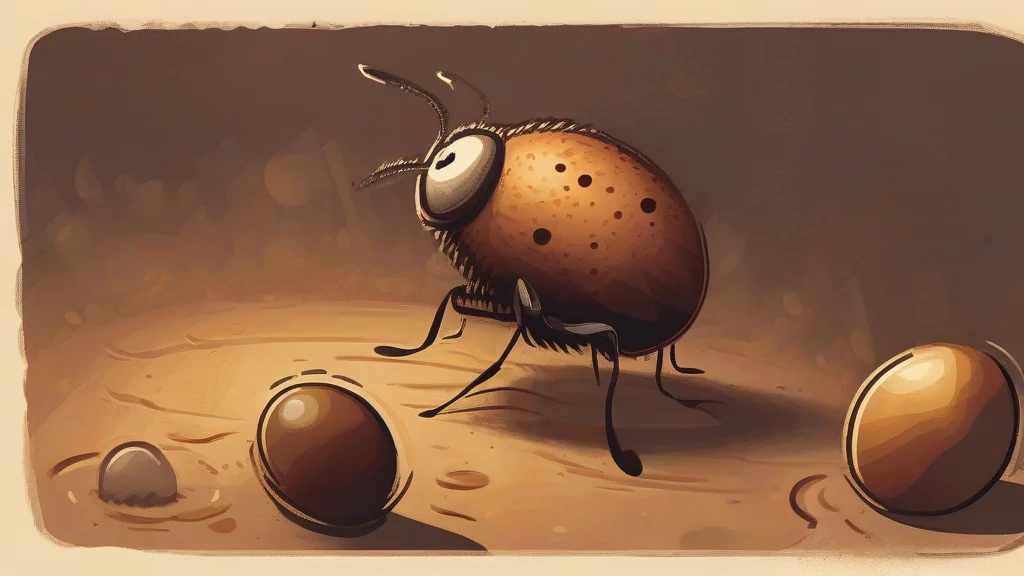
What does flyblow mean?
A flyblow is the egg or newly hatched larva (maggot) of a blowfly, particularly when deposited on meat, carcasses, or living tissue. The term belongs primarily to the vocabulary of food preservation, butchery, and veterinary medicine, where infestation of livestock wounds by blowfly larvae — a condition often called fly strike or myiasis — remains a serious concern for farmers. Related to it is the adjective 'flyblown', describing meat or flesh thus contaminated, and figuratively anything tainted, stale, or morally corrupted, a usage found as early as Shakespeare. The word derives from the older verb 'to blow', which in this context means to deposit eggs, so a fly 'blows' meat by laying eggs on it. Though uncommon in modern casual speech, flyblow survives as a precise, vivid term wherever spoilage and parasitic infestation are discussed, evoking decay so unmistakably that writers have long reached for it to suggest contamination in both matter and character.
An egg or larva (maggot) of a blowfly, especially one deposited on meat or other organic matter.
"Inspecting the hide, the stockman found clusters of flyblow along the animal's flank."
Chiefly used in veterinary and agricultural contexts concerning infestation of livestock.
To lay eggs in or on (flesh, meat, or other organic matter), as a blowfly does; to contaminate in this way.
"Warm summer air meant every hanging carcass risked being flyblown within hours."
Less common than the noun; the derived adjective 'flyblown' is more frequently met.
Rarely pluralized in practice; infestations are usually described collectively or via the adjective 'flyblown'.
"The wound contained numerous flyblows, each no larger than a grain of rice."
Long before refrigeration, cooks could tell spoiled meat at a glance by spotting its flyblow — and Shakespeare used the word 'flyblown' as an insult for something tainted and corrupt.
Reviewed by Deb Chak, Editor. AI-assisted content curated by RJS Tech Solutions LLP.
Etymology of flyblow
The word combines 'fly' with the now largely obsolete verb 'blow', which in this special sense means to deposit eggs on flesh — a usage recorded in English from around the sixteenth century. A fly was said to 'blow' meat when it laid eggs on it, making the resulting eggs or maggots 'flyblow'. The exact earlier origin of this verb 'blow' is not settled, but it gave rise to the adjective 'flyblown', used both literally of contaminated meat and figuratively of anything tainted, a sense famously employed by Shakespeare in ' Antony and Cleopatra'.
Related word forms
How flyblow is actually used
The word is chiefly encountered in technical, agricultural, and veterinary contexts relating to myiasis ('fly strike') in livestock, though 'flyblown' as an adjective also appears figuratively to describe something tainted or decayed. It carries unpleasant connotations of rot and infestation and is rare in everyday conversation.
Easily confused with flyblow
A blowfly is the insect itself, while a flyblow is the egg or maggot it deposits.
'Maggot' refers generally to any fly larva, whereas 'flyblow' specifically denotes the egg or young larva of a blowfly.