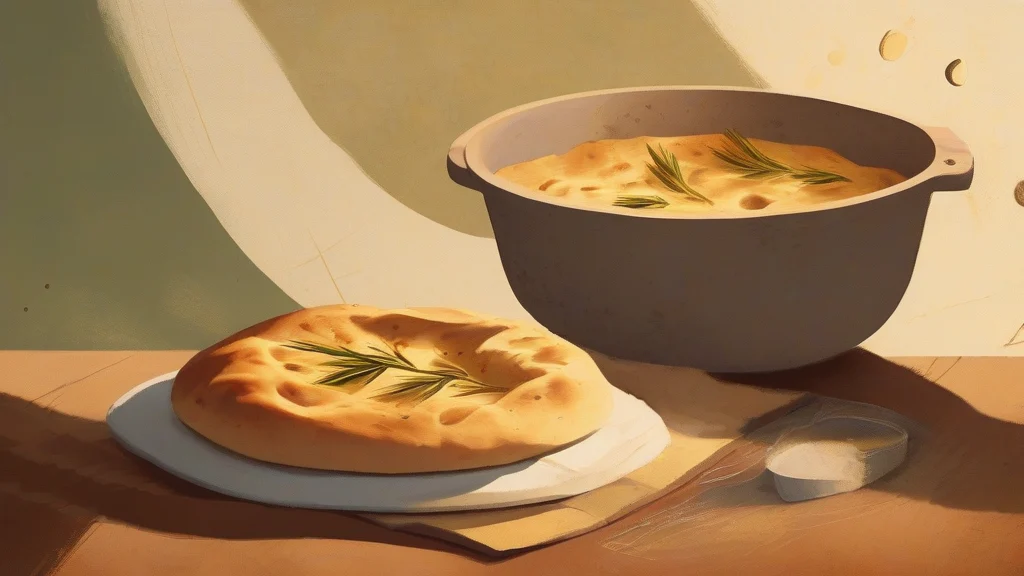
What does focaccia mean?
Focaccia is a flat Italian yeast bread, originating in the Liguria region, that is baked in a shallow pan and generously coated with olive oil before cooking. Its surface is characteristically dimpled — pressed with fingertips to create shallow hollows that catch oil and seasoning — and it is commonly finished with coarse salt, rosemary, or other herbs. The word entered English through Italian and ultimately derives from the Latin focus, meaning 'hearth' or 'fireplace', reflecting bread's ancient association with hearth baking; close relatives include the French fougasse and various regional Italian flatbreads. In modern use, focaccia appears on restaurant menus, in bakeries, and in home kitchens, where it serves both as a side bread and as a base for sandwiches. Its connotations are rustic, Mediterranean, and convivial, evoking shared meals rather than formal dining. The plural is usually focaccias when referring to individual loaves, though the word is frequently treated as uncountable when speaking of the bread in general.
nounA flat Italian yeast bread of Ligurian origin, baked in a shallow pan and typically brushed with olive oil, often topped with salt, herbs, or other flavourings.
- A flat, olive-oil-rich Italian yeast bread baked in a pan, often dimpled on top and seasoned with salt, herbs, or other toppings.
"She tore the warm rosemary focaccia into pieces and passed them around the table."
"The bakery sells out of its tomato-and-oregano focaccia before noon most days."
"For lunch she made a sandwich using thick slabs of leftover focaccia instead of sliced bread."
Focaccia is often treated as a mass noun ('a plate of focaccia'), but when counting separate loaves or varieties the plural 'focaccias' is used. Some writers keep the fully Italian plural 'focacce', though this is rare outside specialist food writing.
"The counter displayed three different focaccias: plain, rosemary, and caramelised onion."
Focaccia's name comes from the Latin word for 'hearth' — meaning this dimpled bread has literally been baked by the same word since ancient Rome.
Reviewed by Deb Chak, Editor. AI-assisted content curated by RJS Tech Solutions LLP.
Etymology of focaccia
Focaccia comes from the Italian dialectal term for hearth-baked flatbread, derived from Latin focus, 'hearth' or 'cooking fire', via the Late Roman panis focacius — bread baked on the hearth itself. The same root produced related European flatbreads such as the French fougasse and Spanish hogaza, all descendants of that original hearth-bread tradition. The word was adopted into English during the twentieth century as Italian cuisine spread internationally, retaining its Italian form throughout.
Related word forms
How focaccia is actually used
Borrowed from Italy in the 20th century, focaccia retains its Italian pronunciation in both British and American usage. It functions as a mass noun when referring to the bread generally ("some focaccia") but takes plural agreement when counting loaves or varieties. The redundant phrase "focaccia bread" is common in commercial contexts, though purists consider it unnecessary since focaccia already denotes a specific bread.
Easily confused with focaccia
Ciabatta is an elongated, slipper-shaped Italian bread with a chewy open crumb, whereas focaccia is flat, pan-baked, and dimpled with a rich olive-oil crust.
Pizza is topped and baked as a meal in itself, while focaccia is a bread that may be flavoured but is not normally covered in sauce and cheese.