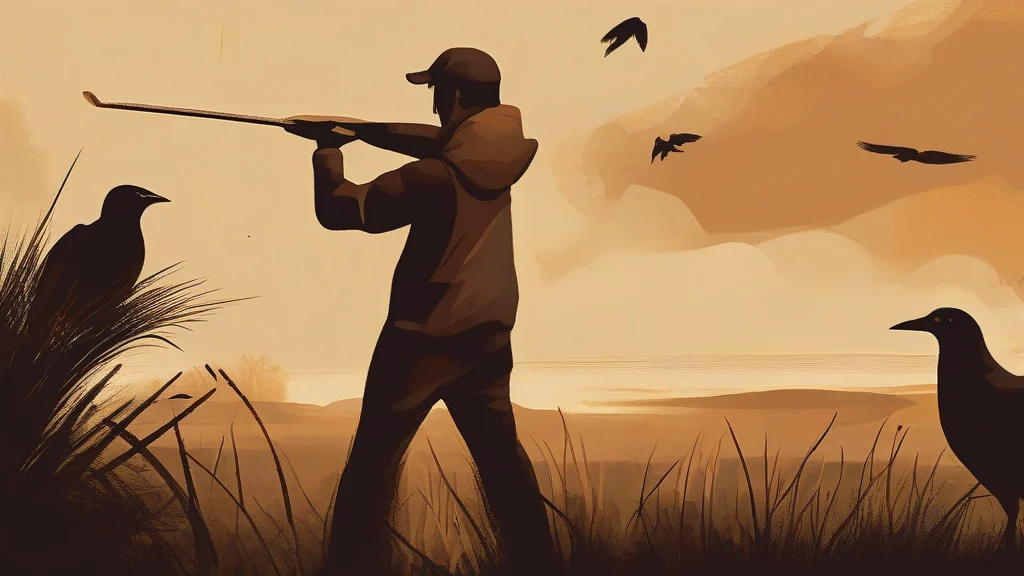
What does fowling mean?
Fowling is the practice of hunting or trapping wild birds, historically for food and feathers and, in modern times, largely as a field sport. The word derives from 'fowl', an ancient Germanic term for birds, particularly those hunted for the table, and it survives in expressions such as 'fowling piece', the light shotgun traditionally carried by bird hunters. Fowling has deep roots: communities across Europe and North America harvested ducks, geese, and other birds along migration routes for millennia, and archaeologists have recovered carved wooden decoys used for exactly this purpose. Today the term sounds somewhat antique, evoking marshes at dawn, muzzle-loading guns, and sporting estates, and it appears mainly in historical writing, hunting literature, and British field-sports contexts, where the variant 'wildfowling' remains current. Understanding fowling connects readers to a long tradition of human reliance on wild birds.
The hunting or trapping of wild birds, especially for food or sport.
"In medieval England, fowling with nets and snares was a familiar part of the countryman's year."
Functions as an uncountable activity noun; in Britain it often appears as 'wildfowling' when waterbirds are the quarry.
The sporting use of a fowling piece — a light shotgun designed for shooting birds in flight.
"He was a noted shot, celebrated for his skill with the fowling piece."
This sense is largely historical and appears in older sporting literature.
As an activity noun, fowling is uncountable and does not take a plural; related countable nouns such as 'fowl' pluralize regularly.
"Fowling was strictly regulated on the estate during the winter months."
The oldest known duck decoys in the world — roughly 3,000 years old — weren't made for collectors; they were tools of fowling.
Reviewed by Deb Chak, Editor. AI-assisted content curated by RJS Tech Solutions LLP.
Etymology of fowling
Fowling comes from 'fowl', which descends from Old English 'fugol', a common Germanic word for bird related to Old Norse 'fugl' and reflected in modern German as 'Vogel'. The verb-derived activity noun 'fowling' denoted the capture or shooting of wild birds, a practice central to medieval diet and country life. The compound 'fowling piece' emerged as firearms developed, naming a light gun suited to bird shooting. Cognates across the Germanic languages preserve the same root, including 'waterfowl' and 'wildfowl' in English.
Related word forms
How fowling is actually used
Fowling is an uncountable activity noun, closely tied to field-sports vocabulary in Britain (where 'wildfowling' is a common variant) and to hunting tradition in North America. It carries an old-fashioned, rural register today and appears most often in historical, sporting, or heritage contexts rather than everyday speech. The related term 'fowling piece' refers specifically to a light shotgun used for shooting birds.
Easily confused with fowling
Fouling means making something dirty or contaminated (as in 'fouling a nest' or marine fouling), while fowling means hunting wild birds — they differ by a single letter and are occasionally mixed up in writing.