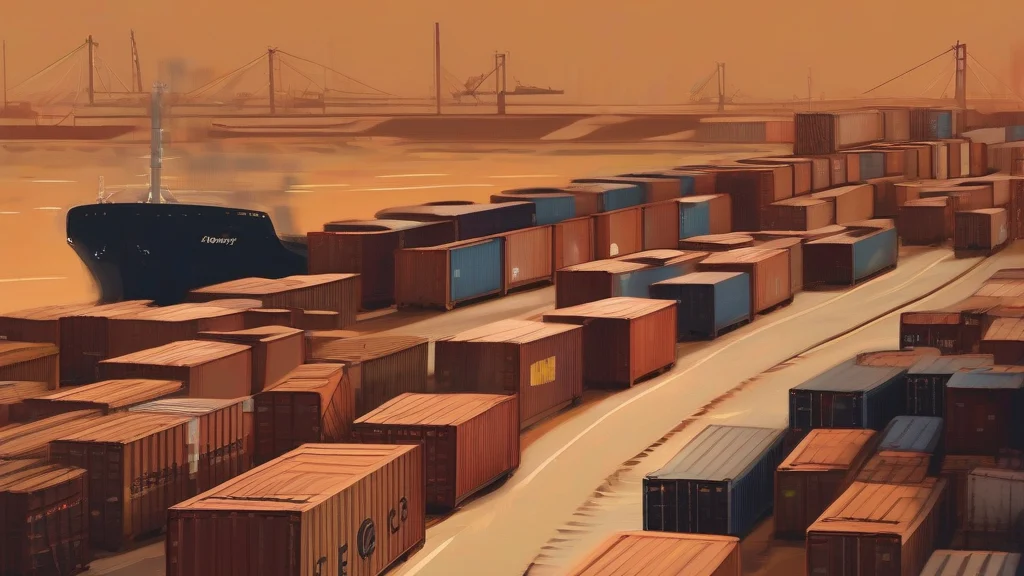
What does freighted mean?
Freighted is the past tense and past participle of the verb 'freight', which has two related lives. Literally, it describes goods that have been loaded onto a ship, train, truck, or aircraft for commercial transport: 'The vessel was freighted with timber.' Figuratively, it carries a subtler and more literary meaning: a statement, gesture, or moment can be 'freighted with' meaning, history, emotion, or consequence — that is, made heavy with significance beyond its surface. This figurative use is especially at home in essays, literary criticism, and formal prose, where writers use it to signal that something plain-seeming bears a substantial hidden weight. The word derives from the same commercial vocabulary as 'freight' itself, and its double life — from cargo holds to charged silences — makes it a compact example of how the language of trade becomes the language of ideas.
Past tense and past participle of 'freight': to have loaded goods onto a ship, vehicle, or aircraft for transport, or figuratively to have burdened something with meaning or responsibility.
"The barge was freighted with cotton for the mills upriver."
In figurative use, typically followed by 'with', as in 'freighted with significance'.
Describing something laden or heavily weighted, either with physical cargo or, figuratively, with emotional, historical, or symbolic significance.
"It was a small ceremony, but one freighted with decades of family memory."
A word can be 'freighted with meaning' — which is exactly why writers reach for this old shipping term when they want to say something carries more weight than it appears to.
Reviewed by Deb Chak, Editor. AI-assisted content curated by RJS Tech Solutions LLP.
Etymology of freighted
The verb 'freight', whose past participle is 'freighted', entered English in the Middle Ages from Dutch or Frisian terms such as 'vracht' or 'vrecht', meaning the hire or carriage of goods by water, itself rooted in Germanic forms related to carrying and loading. It is thus a sibling, not a descendant, of 'fright', despite the visual similarity between the two words. From its maritime-commercial origins, the verb extended by metaphor into general usage, so that anything weighed down — physically with cargo or abstractly with significance — can be described as freighted.
Related word forms
How freighted is actually used
The literal sense belongs chiefly to commercial and transport contexts, while the figurative sense — 'freighted with meaning, history, or consequence' — is common in literary criticism and formal writing. In figurative use, the phrase almost always appears as 'freighted with' rather than alone; 'freighted' on its own usually signals the literal cargo sense. The tone is somewhat elevated in figurative use.
Easily confused with freighted
'Frighted' means frightened or scared (an archaic form), while 'freighted' means loaded with cargo or burdened with significance — the two differ only slightly in spelling but entirely in meaning.