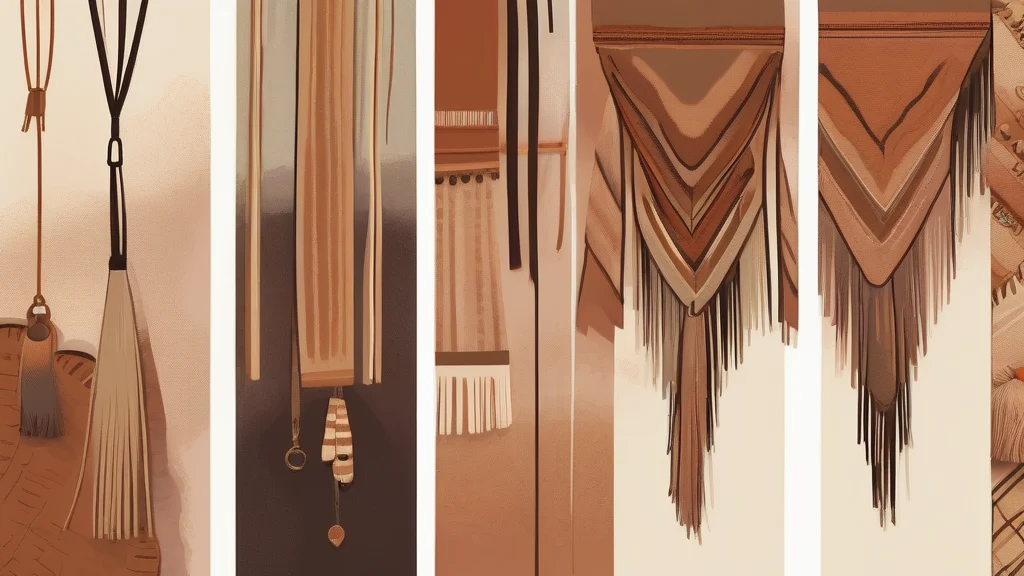
What does fringing mean?
Fringing denotes a decorative border made up of loose hanging threads, cords, or tassels applied to the edge of textiles such as scarves, blankets, curtains, rugs, and garments. It functions primarily as a noun naming the trim itself, though it also serves as the gerund of the verb 'to fringe', describing the act of attaching such an edging. Fringing appears throughout craft, fashion, and home décor vocabulary, associated with handmade goods, bohemian style, and traditional weaving. The word derives from 'fringe', which entered English from French in the early modern period and ultimately traces to the Latin 'fimbria', meaning fiber or thread. Because it describes both a physical object and a technique, fringing is useful in pattern instructions, product descriptions, and historical discussions of costume and upholstery alike.
A decorative border of loose threads, cords, or tassels attached to the edge of a garment, rug, curtain, or other textile.
"The velvet cushion was finished with a deep gold fringing."
Often used in craft and sewing contexts when discussing materials for trimming.
The gerund form of 'fringe': the act of decorating or bordering something with a fringe.
"Fringing the hem took her most of the afternoon."
Typically appears in instructions or descriptions of craftwork.
Rarely pluralized in practice; the singular usually suffices even when referring to multiple pieces of trim, since context makes quantity clear.
"Several colorful fringings were laid out on the worktable."
That dangling trim on your scarf has Latin roots — it traces back to 'fimbria', the Roman word for a thread or fiber.
Reviewed by Deb Chak, Editor. AI-assisted content curated by RJS Tech Solutions LLP.
Etymology of fringing
Fringing derives from 'fringe', a word adopted into English from French during the sixteenth or early seventeenth century, referring to an ornamental border of loose threads. The French term likely stems from Late Latin 'fimbria', denoting a fiber or border, the same root behind 'fimbriated', used in heraldry and biology for objects edged with fine filaments. As textile arts developed, 'fringing' emerged as the natural noun and gerund form covering both the trim and its application.
Related word forms
How fringing is actually used
Fringing is used mainly in craft, fashion, and interior design contexts and carries a neutral to slightly decorative connotation. In British English it appears frequently in knitting and crochet patterns; in American usage, 'fringe' itself often substitutes for the noun.
Easily confused with fringing
'Fringe' can refer to any decorative border or, in other senses, to the outer edge of something (or hair over the forehead), whereas 'fringing' specifically names the material of loose hanging threads or the act of applying such trim.