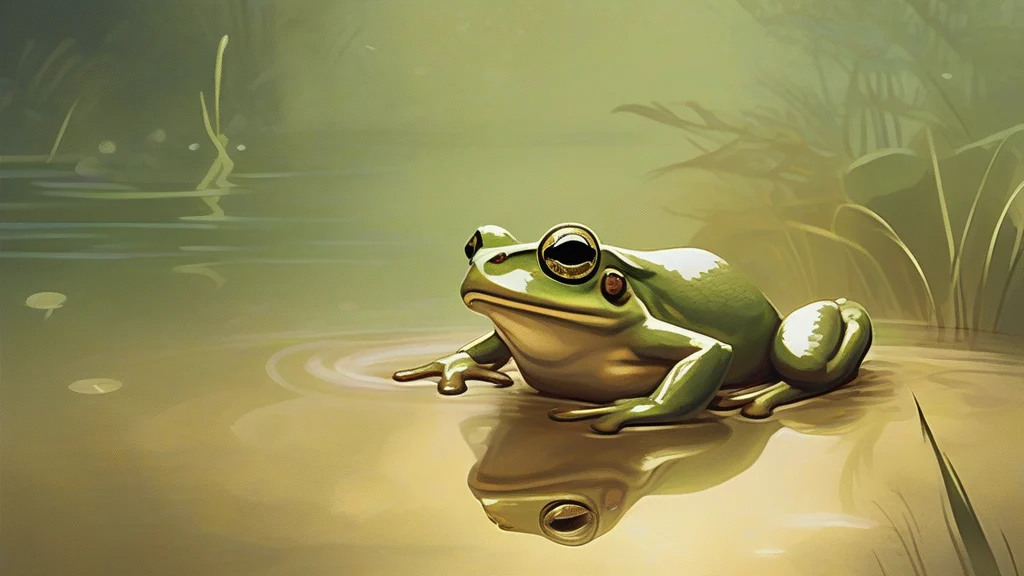
What does frog mean?
The frog is a tailless amphibian known for its powerful hind legs, bulging eyes, and characteristic leap. Found on every continent except Antarctica, frogs begin life as aquatic tadpoles and undergo metamorphosis into air-breathing adults, making them a classic example of biological transformation. Smooth-skinned and largely moisture-dependent, they are distinct from their warty cousins, the toads. Beyond natural history, the word carries rich figurative life: a 'frog in the throat' describes temporary hoarseness, while the proverbial 'boiling frog' warns of dangers that creep in gradually — even though the underlying experiment is a myth. The frog also stars in folklore, most famously as the prince awaiting a kiss. With its distinctive croak and its place in fables, science lessons, and childhood ponds alike, 'frog' is a word that bridges everyday language, biology, and story.
nounA tailless, jumping amphibian with smooth, moist skin, long hind legs adapted for leaping and swimming, and a life cycle that progresses from aquatic tadpole to air-breathing adult.
- A tailless amphibian of the order Anura, with smooth moist skin and long hind legs for jumping and swimming.
- The wedge-shaped, elastic structure in the underside of a horse's hoof (farriery terminology).
- A decorative fastening of corded loops and a toggle used on coats and other garments.
"We could hear frogs croaking from the pond all through the summer evening."
"The children spent the afternoon catching tadpoles at the edge of the pond, hoping to watch them turn into frogs."
"Excuse my voice — I've had a frog in my throat all morning."
Standard plural; when referring to multiple species collectively, 'frogs' remains correct (e.g. 'frogs are declining worldwide').
"Dozens of frogs emerged from the marsh after the spring rains."
A frog can breathe partially through its skin, which is why it has to stay damp — and why the fairy-tale frog is always found near water.
Reviewed by Deb Chak, Editor. AI-assisted content curated by RJS Tech Solutions LLP.
Etymology of frog
The word 'frog' descends from the Old English 'frogga', a short, stout form of the name these amphibians bore in early Germanic languages. It is related to comparable forms in other Germanic languages, such as Old Norse 'froskr' and modern German 'Frosch', pointing to a shared Germanic root. An earlier Old English variant, 'frosca' (later reflected in the archaic form 'frosh'), shows the word's development before it settled into its modern shape in Middle English. The name likely derives ultimately from the hopping motion characteristic of the animal.
Related word forms
How frog is actually used
'Frog' is a common, neutral word across registers. In farriery, the term for the hoof structure is specialist vocabulary unfamiliar to most laypeople. Historically, the word was also used as an ethnic slur against French people, particularly in older British writing; this usage is offensive and should be avoided entirely. Among knitters, 'frogging' informally means unravelling stitches (a joke playing on 'ribbit, ribbit').
Easily confused with frog
Toads are a related group of amphibians with drier, warty skin that tend to walk rather than leap, whereas 'frog' properly refers to the smooth-skinned, strong-jumping members of the order Anura.