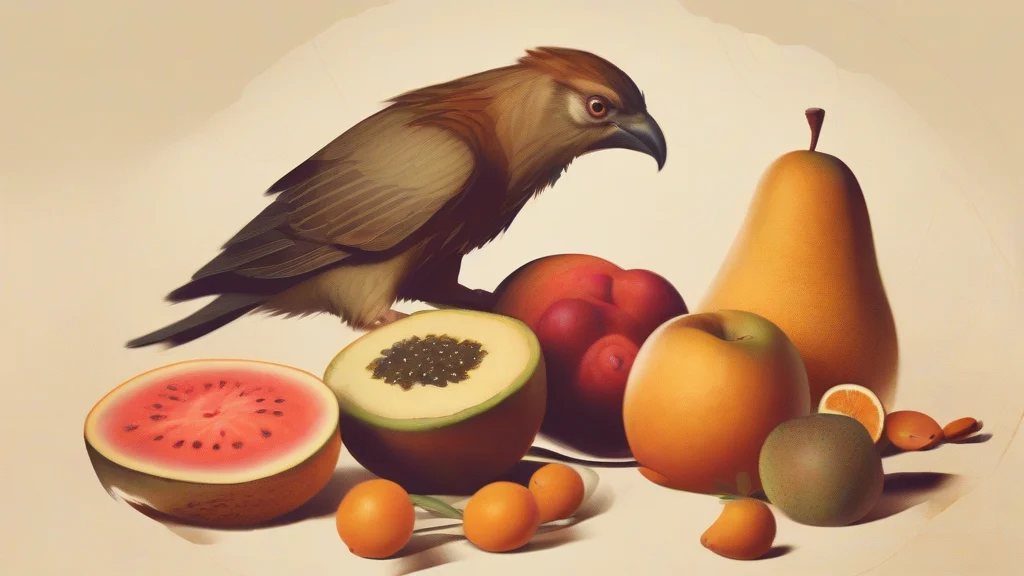
What does frugivore mean?
A frugivore is an animal that feeds chiefly on fruit—a category that spans a remarkable range of species, from orangutans and toucans to fruit bats, civets, and certain fish and lizards. The word belongs primarily to scientific vocabulary, appearing most often in ecology, zoology, and conservation biology, where researchers study how fruit-eating animals shape forest dynamics. Its importance goes well beyond diet: many plants rely on frugivores to swallow their fruit and disperse seeds far from the parent tree, making these animals essential partners in tropical ecosystems. The term derives from the Latin roots frug-, meaning fruit or produce, and -vore, meaning to devour, echoing related classifications such as herbivore and carnivore. While frugivores are technically omnivorous in many cases—supplementing fruit with insects or leaves—the label describes their dominant food source. Understanding frugivory helps scientists protect forests, since losing fruit-eating animals can mean losing the trees that depend on them.
nounAn animal that feeds primarily on fruit; a fruit-eater.
- An animal whose diet consists primarily or largely of fruit.
"Fruit bats are important frugivores, dispersing seeds across entire rainforests as they feed."
"Toucans are among the most visible frugivores of the Neotropical forest canopy."
"The study tracked how seasonal changes altered which frugivores visited the strangler fig trees."
Standard English plural; used routinely in ecological research when discussing multiple fruit-eating species or populations.
"The reserve protects a diverse community of frugivores, from hornbills to macaques."
Every fig tree you've ever seen exists because a frugivore swallowed its seeds and flew them somewhere new.
Reviewed by Deb Chak, Editor. AI-assisted content curated by RJS Tech Solutions LLP.
Etymology of frugivore
Frugivore comes from the combination of two elements: Latin frug-, from frux (fruit, produce, or crops), and the suffix -vore, derived from vorare ('to devour'), the same root behind herbivore, carnivore, and omnivore. The compound follows the pattern established by those earlier animal-classification terms, and the adjective form frugivorous appeared first in natural-history writing before the noun became standard. Related words drawing on the same Latin root include frugal and frugality, both concerned with thrift and economy.
Related word forms
How frugivore is actually used
Frugivore is a technical term used mainly in zoology, ecology, and evolutionary biology; it rarely appears in casual conversation. It applies across animal groups—mammals, birds, fish, even some reptiles—and carries no connotation beyond dietary classification. In scientific writing it often appears in discussions of mutualism and seed dispersal, since fruit-eating animals frequently serve as seed dispersers for the plants they feed on.
Easily confused with frugivore
Frugivore is the noun naming the animal itself, while frugivorous is the adjective describing something that eats fruit.
A granivore eats seeds rather than the fleshy fruit that a frugivore consumes.