What does furrowing mean?
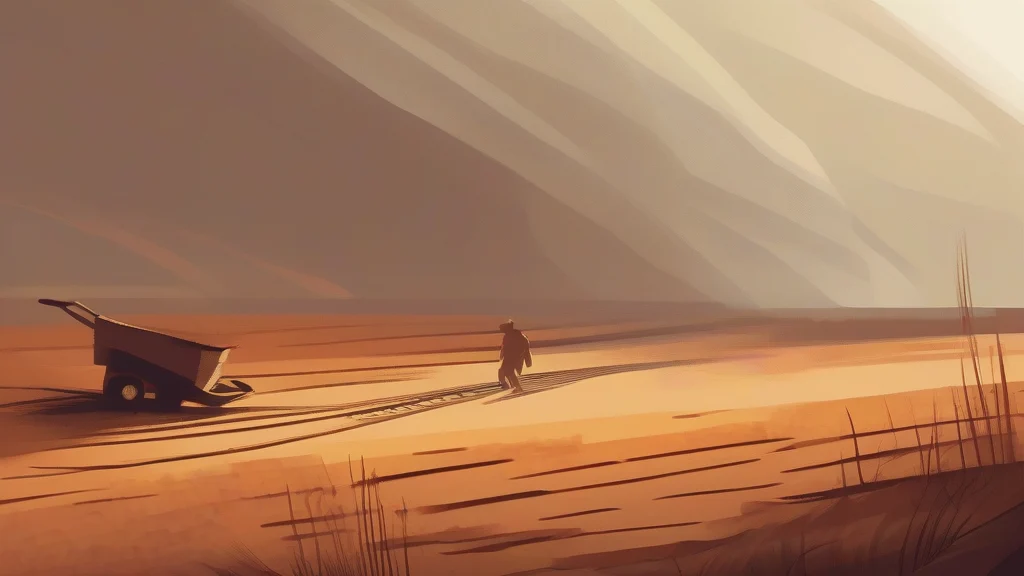
Furrowing is the present participle of the verb 'furrow', meaning to cut long, narrow trenches or grooves into soil, most often with a plough, or to form deep lines and wrinkles in a surface — especially the human brow. In modern English the figurative sense dominates: a worried reader's forehead may be described as 'furrowing' as concentration or concern etches visible creases across it. The word carries strong visual and tactile connotations, evoking both orderly agricultural landscapes and the weathered texture of an expressive face, which makes it a favourite of novelists and journalists alike. Its agricultural sense persists mainly in farming descriptions, where furrowing prepares fields for planting by creating rows that channel water and seed. Derived from Old English 'furh', meaning a trench, it belongs to a small family of words linking ploughing and facial expression through a single vivid image of grooved lines.
To cut long, narrow trenches or grooves in soil, or to form wrinkles or creases in a surface such as the brow.
"Standing at the window, she watched him pacing the garden, his brow furrowing with each unanswered question."
Almost always used in the progressive or participial form rather than as a finite verb in modern usage.
The action or process of making furrows; the state or appearance of being furrowed.
"The constant furrowing of his brow had left deep lines by middle age."
Less common than the verbal use; typically appears in descriptive passages about physical features or landscape.
That tiny frown line between your eyebrows has a name borrowed straight from the farm: it's literally a 'furrow', the same trench a plough cuts through a field.
Reviewed by Deb Chak, Editor. AI-assisted content curated by RJS Tech Solutions LLP.
Etymology of furrowing
Furrowing derives from the verb 'furrow', which comes from Old English 'furh', meaning a trench or groove, and shares a common Germanic root with related words in other Germanic languages, such as Old High German 'furuh' and Old Norse 'for'. This Germanic base is cognate with Latin 'porca', a ridge between furrows, pointing to a broader Indo-European origin connected to ploughed land. The verb took on its figurative sense — forming wrinkles in the brow — as the image of ploughed grooves was applied metaphorically to lined skin.
Related word forms
How furrowing is actually used
Furrowing functions chiefly as the present participle and gerund of the verb 'furrow'. The figurative sense involving the brow is by far the most common in everyday modern usage, appearing frequently in descriptive writing about faces and expressions; the agricultural sense is now mostly confined to farming contexts. The register is neutral, fitting both formal prose and casual speech.
Easily confused with furrowing
Burrowing means digging a hole or tunnel (as an animal does), while furrowing means cutting grooves in soil or creasing a surface.