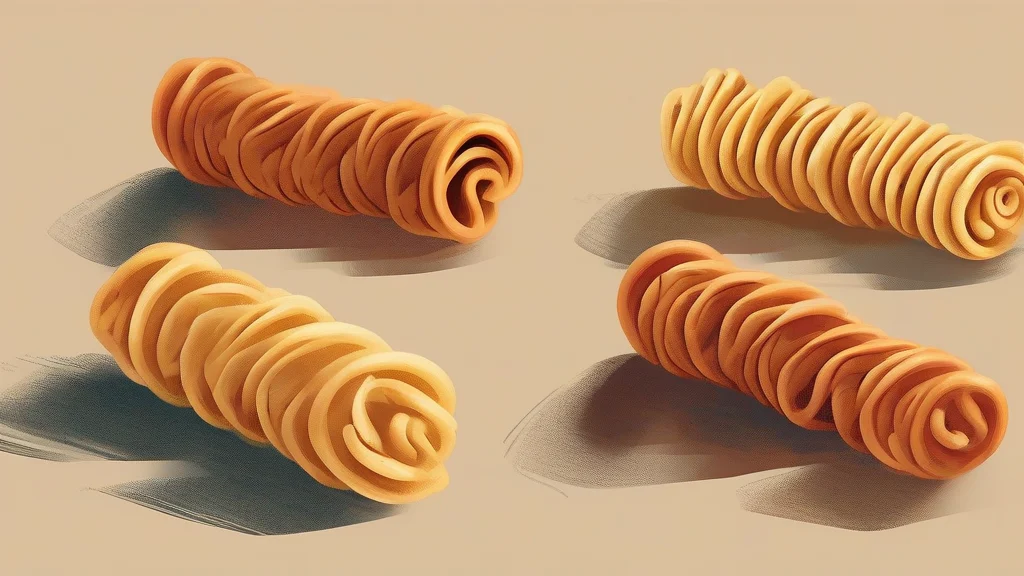
What does fusilli mean?
Fusilli is a variety of pasta characterised by its short length and distinctive corkscrew or helical shape, a form that originated in southern Italy, where the strands were traditionally twisted by hand around a slender iron rod. The name derives from the Italian 'fuso', meaning spindle, reflecting this method of manufacture. Because its ridges and coils are adept at trapping sauces, pesto, and small pieces of vegetable or meat, fusilli is a popular choice for both hot dishes and cold pasta salads. In everyday English the word functions as an uncountable noun within cooking contexts, appearing on restaurant menus, in recipes, and on supermarket shelves alongside related shapes such as rotini and penne. Though essentially a specialist culinary term rather than part of general vocabulary, fusilli is widely recognised wherever Italian cuisine is eaten, and its playful spiral form has made it a familiar staple of home kitchens worldwide.
nounFusilli is a type of pasta formed into short spirals or corkscrews, originally from southern Italy. Its twisted shape is designed to hold sauces, dressings, and small ingredients.
- A short pasta shaped like a corkscrew or spiral, originating from southern Italy.
"She tossed the fusilli with roasted cherry tomatoes, basil, and a generous drizzle of olive oil."
"The recipe calls for four hundred grams of fusilli."
"Cold fusilli holds up well in picnic salads because the grooves trap the dressing."
In English, fusilli usually functions as a mass noun and remains unchanged; the Italian plural form is identical, and an anglicised plural 'fusillis' occasionally appears but is not standard.
"The store sells fusilli in five-hundred-gram bags."
Fusilli gets its name from the Italian word for 'spindle' — the pasta was traditionally twisted by hand around a thin rod called a ferretto, much like wool was once wound onto spindles.
Reviewed by Deb Chak, Editor. AI-assisted content curated by RJS Tech Solutions LLP.
Etymology of fusilli
Fusilli comes from the Italian 'fuso', meaning 'spindle', which itself descends from the Latin 'fusus'. The name refers to the traditional craft of winding strips of pasta dough around a thin rod to create the characteristic spiral. The word entered English through Italian cuisine, retaining its Italian plural form. Related terms from the same Latin root include 'fusiform', describing a spindle-shaped structure in biology.
How fusilli is actually used
Fusilli is used almost exclusively in culinary contexts. In British and American usage it is treated as a mass noun; it is sometimes inflected as 'fusillis' in casual English, though careful usage treats the word as plural in form or unchanged when referring to a quantity of the pasta.
Easily confused with fusilli
Rotini and fusilli are both spiral pastas, but rotini is typically made by extrusion while traditional fusilli is made by twisting strips of dough around a rod.
Fuselage refers to the main body of an aircraft, whereas fusilli is a corkscrew-shaped pasta; they share a root in the Latin word for spindle but have entirely different meanings.