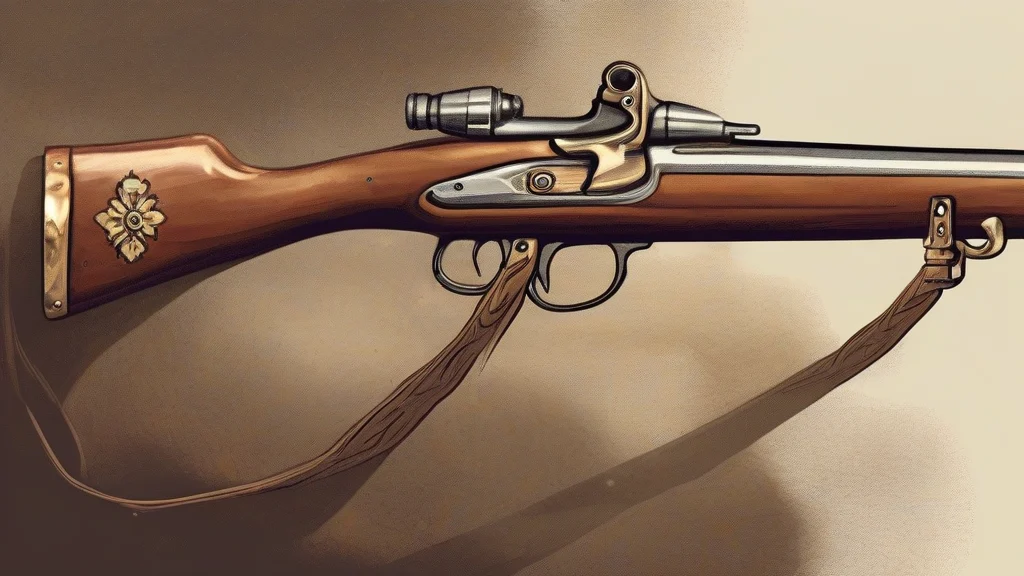
What does fusil mean?
The word fusil denotes a light flintlock musket, notably shorter and easier to handle than the standard infantry musket of the seventeenth and eighteenth centuries. Because of their manageable weight, fusils were typically issued to officers, sergeants, artillerymen, and light troops rather than to line infantry. The name also survives in heraldry, where a fusil is a small elongated diamond-shaped charge, slimmer than a conventional lozenge, that can be borne alone or arranged in rows across a shield. The term derives ultimately from the Latin verb fundere, meaning to pour or to melt, a nod to the casting of early firearms, and reached English by way of medieval French. Today fusil appears mostly in military history and heraldic literature, though in modern French it remains the everyday word for a gun. Its blend of martial and heraldic associations makes it a distinctive term for anyone interested in the language of arms and armorial bearings.
nounA fusil is a light flintlock musket used chiefly by infantry officers and light troops, shorter and lighter than the standard musket of its day. In heraldry, a fusil is also a small charge shaped like an elongated lozenge.
- A light flintlock musket, shorter than the standard infantry musket, formerly carried by officers, sergeants, and light troops.
- In heraldry, a charge in the shape of an elongated lozenge, narrower than a true lozenge.
"The officer carried a fusil slung across his back as he led the skirmishers through the wood."
"The grenadier's fusil cracked once and the smoke drifted across the parade ground."
"The heraldic shield bore three fusils in fess, each a slender diamond of gold on azure."
The plural follows standard formation; in heraldry, charges are often described in groups, e.g. 'three fusils in fess'.
"The coat of arms displayed three fusils in a horizontal row."
The word 'fusil' traces back to Latin 'fundere' — to pour or melt — because early firearms were cast like molten metal poured into a mould.
Reviewed by Deb Chak, Editor. AI-assisted content curated by RJS Tech Solutions LLP.
Etymology of fusil
Fusil entered English from French during the era of the flintlock firearm, taking its name from the French fusil, itself descended from the Latin fusilis, meaning 'capable of being melted or cast', formed on the verb fundere, 'to pour'. This metallurgical root reflects the cast construction of early gun barrels. The same Latin verb gives English such cognates as fusion, diffuse, and transfuse. A separate heraldic sense developed from the shape's resemblance to a spindle or distaff, which is also related to the idea of spinning and casting in early craft terminology.
How fusil is actually used
As a firearm term, 'fusil' is now largely historical, appearing mainly in military history writing about the 17th and 18th centuries. The heraldic sense survives among students of heraldry. In modern French, 'fusil' remains the ordinary word for a gun, so readers may encounter it translated directly in French contexts.
Easily confused with fusil
A fusee is a conical pulley in a clock mechanism or an early type of light musket, whereas the fusil is the flintlock firearm itself; the two names overlap historically but refer to different objects in modern usage.
A musket was the heavier standard infantry firearm, while the fusil was a lighter, shorter version originally issued to officers and troops needing easier handling.