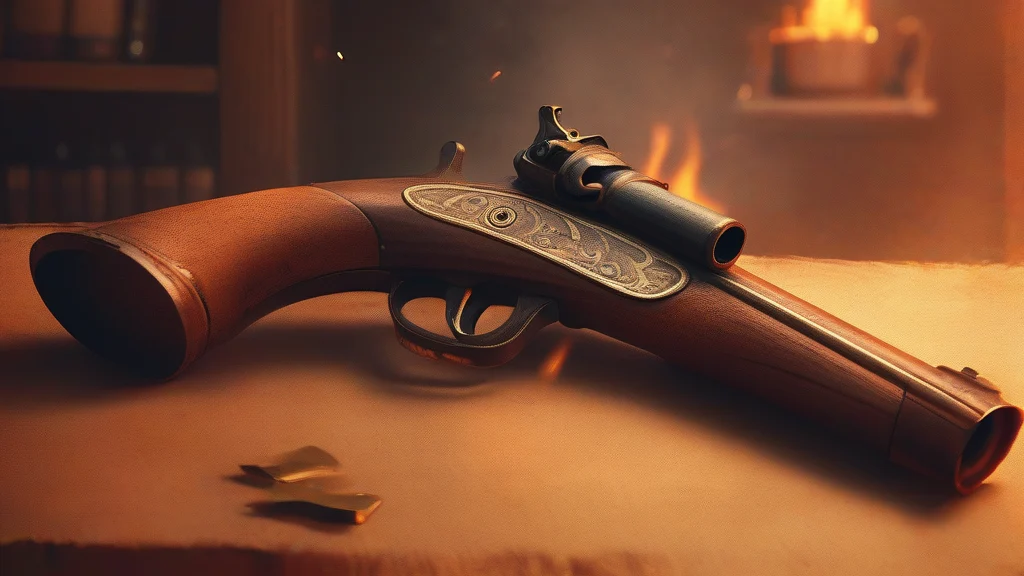
What does firelock mean?
A firelock is a muzzle-loading firearm that is discharged by a mechanical spark-generating lock rather than by the smouldering cord used in earlier matchlock guns. The word dates to the sixteenth and seventeenth centuries, when European armies were replacing matchlocks — which required keeping a length of slow-burning fuse alight, exposing troops at night and in damp weather — with mechanisms that struck sparks from pyrite or, later, flint against steel. Because the term covered any such self-igniting lock, it embraced both wheel locks and flintlocks, and it became the standard generic label for military small arms of this kind. Today "firelock" survives mainly in historical writing, museums, and the vocabulary of collectors and reenactors, evoking the era of pike-and-shot warfare and the redcoat musketeer. Its companion terms "matchlock" and "flintlock" are useful anchors for distinguishing the successive generations of ignition technology it describes.
A muzzle-loading firearm in which the charge is ignited by a mechanical spark-producing lock, such as a flintlock or wheel lock, rather than by a slow-burning match.
"By the early eighteenth century every infantryman carried a firelock in place of the obsolete matchlock."
In historical military records the term functioned as a general category covering several ignition mechanisms, most famously the flintlock.
The lock mechanism of such a firearm — the assembly that generates the spark and discharges the weapon.
"The gunsmith fitted a new flint into the firelock before the shooting demonstration."
Standard regular plural; in historical texts it often appears when describing soldiers' arms being stacked, issued, or inventoried.
"The regiment stacked its firelocks along the palisade at dusk."
'Firelock' was once the high-tech military buzzword of its day — the name itself was a security measure, because calling these guns 'firelocks' let English armies order them without revealing to enemies that they'd abandoned the slow-burning match cord.
Reviewed by Deb Chak, Editor. AI-assisted content curated by RJS Tech Solutions LLP.
Etymology of firelock
The word "firelock" combines "fire," from Old English "fȳr," with "lock," from Old English "loc," meaning a fastening mechanism — here applied to the gun's firing mechanism. It arose in the sixteenth century to distinguish firearms ignited by a mechanical spark (originally wheel-lock designs using pyrite, later flintlocks) from matchlocks fired by a burning cord. It belongs to a family of armament terms built on "lock," alongside "matchlock" and "flintlock."
How firelock is actually used
"Firelock" is now almost entirely historical, appearing in discussions of early modern warfare, antique collecting, and reenactment. In period military documents it often served as a generic official term for spark-ignited small arms, including flintlocks and earlier wheel locks.
Easily confused with firelock
A flintlock is one specific type of ignition mechanism (using a piece of flint striking steel), while 'firelock' is the broader older term for any gun fired by such a mechanical spark-generating lock, as opposed to a matchlock.
A matchlock ignites powder with a slow-burning cord held in a pivoting arm, whereas a firelock ignites it mechanically by a spark without any burning match.