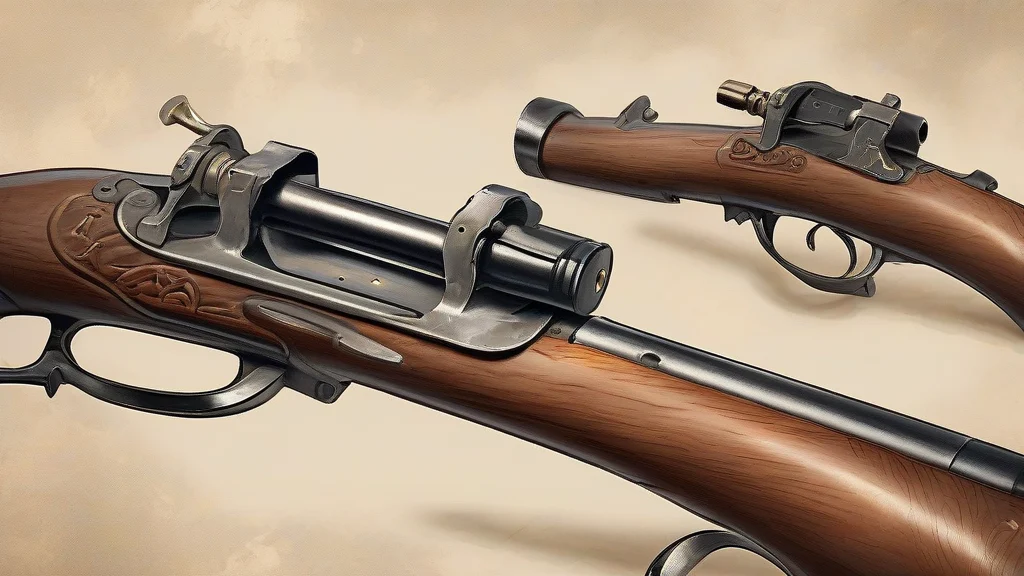
What does flintlock mean?
A flintlock is a type of firearm ignition system — and, by extension, any gun built around it — in which a piece of flint clamped in the jaws of the hammer snaps against a steel plate (the frizzen), producing sparks that ignite priming powder and fire the charge. Developed in France in the early 17th century as an improvement over the unreliable matchlock, the flintlock became the dominant firearm mechanism worldwide for roughly two hundred years, arming the armies and navies of the age of revolution. It was eventually superseded in the 19th century by the more weatherproof percussion-cap system. Today the word appears chiefly in historical, military, and collecting contexts, evoking redcoats, privateers, and duels at dawn. Its enduring cultural resonance makes it a staple of museum displays, historical reenactment, and period fiction.
The flint-ignited firing mechanism of a firearm, in which a spark from flint striking steel ignites the priming powder.
"The flintlock was prone to misfiring in damp weather."
Often used attributively before a noun naming the weapon, as in "flintlock musket."
A firearm — typically a musket or pistol — fitted with a flintlock mechanism.
"He displayed a beautifully preserved flintlock above the fireplace."
The standard plural applies to both senses: mechanisms or complete firearms.
"The armoury held dozens of flintlocks from the Napoleonic era."
For nearly two centuries, every shot fired on land and sea — from colonial frontiers to Trafalgar — began with a spark struck from a piece of flint.
Reviewed by Deb Chak, Editor. AI-assisted content curated by RJS Tech Solutions LLP.
Etymology of flintlock
The word "flintlock" is a straightforward English compound of "flint," the hard stone struck to create sparks (from Old English "flint"), and "lock," the term for a gun's firing mechanism, itself from Old English "loc" meaning a fastening device. The compound arose in English in the late 17th century, when the mechanism it names was spreading across Europe from its French origins. Both elements are Germanic in origin, giving the word a wholly native pedigree despite the technology's continental development.
How flintlock is actually used
"Flintlock" is a historical and largely technical term today, appearing most often in discussions of military history, antique collecting, museums, and period fiction. It is neutral in register but carries strong connotations of the 17th-to-early-19th-century era; figurative use is rare.
Easily confused with flintlock
A matchlock ignites powder using a slow-burning match rather than the flint-and-steel spark of a flintlock, and is an earlier technology.
A percussion lock detonates a small explosive cap to fire the weapon, replacing the flintlock's spark mechanism from the 1820s onward.