What does gaggling mean?
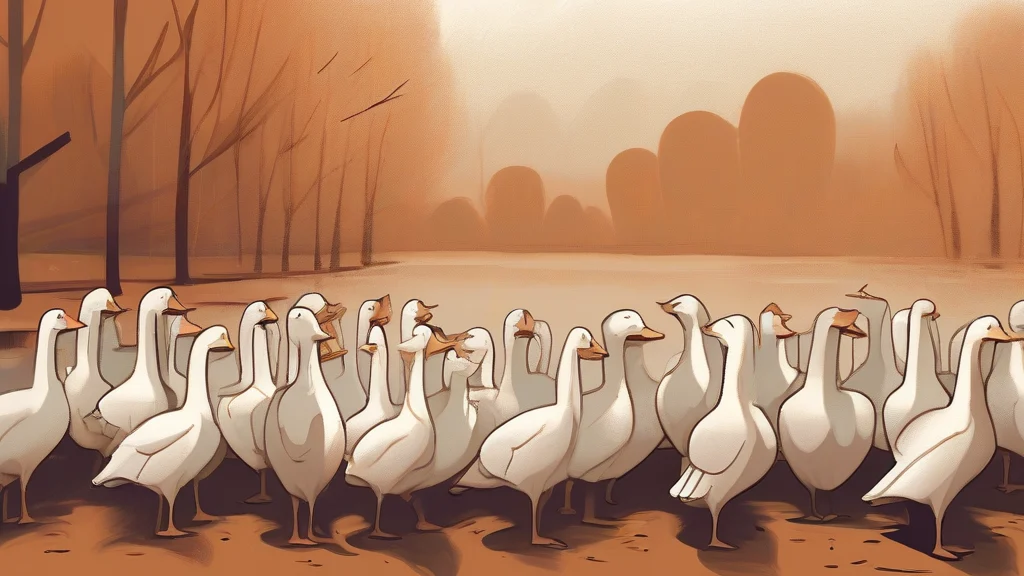
Gaggling is the present participle of the verb 'to gaggle', which describes two closely linked kinds of noise. In its primary sense it refers to the distinctive cackling call made by geese — the sound a flock produces as it feeds, flies, or objects to your presence. By extension, the word is applied to groups of people who chatter loudly and move about in a disorganized cluster: gaggling tourists crowding a landmark, or schoolchildren gaggling through a museum corridor. The figurative use draws on the long-standing English tradition of comparing noisy human crowds to flocks of geese, and it usually carries a mildly mocking connotation, suggesting aimlessness and excessive noise rather than purposeful conversation. The word traces back to Middle English, where 'gaggle' arose as an imitative rendering of the goose's harsh cry. It remains a vivid, economical choice for writers who want to convey both sound and disorder in a single stroke.
verbThe present participle and gerund of the verb 'gaggle': to make the noisy, cackling cry characteristic of geese, or, by extension, for a group of people to chatter noisily and incoherently.
- To make the cackling cry of a goose (used especially of geese).
- Of people: to talk or move about noisily and in an unorganized, chattering group.
"A flock of geese came gaggling across the pond as we approached."
"Geese went gaggling overhead as the harvest began."
"A crowd of excited teenagers stood gaggling outside the theatre doors."
When geese do it, it's ornithology; when tourists do it, it's an insult — 'gaggling' is one of the few words that works equally well for birds and badly-behaved crowds.
Reviewed by Deb Chak, Editor. AI-assisted content curated by RJS Tech Solutions LLP.
Etymology of gaggling
The word derives from 'gaggle', a term attested in Middle English and generally understood to be imitative in origin, echoing the harsh cackling sound of geese. It belongs to the same family of onomatopoeic English verbs as 'gabble'. The extension from bird cries to noisy human chatter developed naturally, since English writers have long likened clamorous crowds to flocks of geese.
Related word forms
How gaggling is actually used
The figurative sense applied to people is informal and often mildly derisive, implying that a group is loud, aimless, or disorganized — the comparison to geese is rarely flattering. It is most common in descriptive journalism and casual narrative prose rather than formal writing.
Easily confused with gaggling
Giggling is light, often suppressed human laughter, whereas gaggling is either the harsh cackle of geese or loud, unruly human chatter.