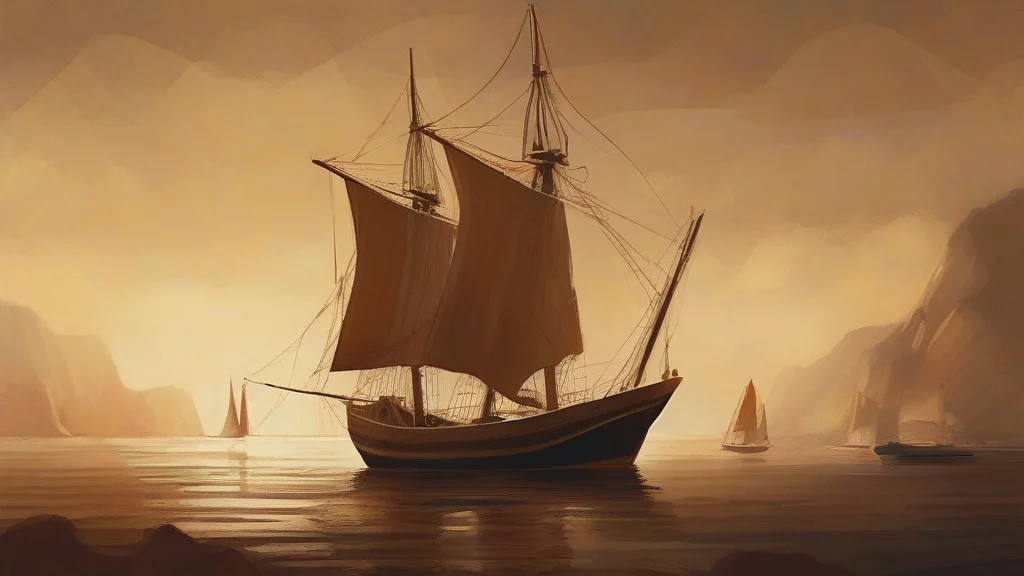
What does galliot mean?
A galliot is a small, swift sailing vessel that played a notable role in European maritime history. Best known as a two-masted merchant craft favoured by Dutch traders from roughly the sixteenth century onward, it was prized for its speed, modest size, and suitability for coastal and short-sea voyages carrying bulk goods such as grain, timber, and wine. In earlier Mediterranean usage the term also described a light oared vessel resembling a miniature galley, sometimes employed for raiding or dispatch duties. The word derives ultimately from the same lineage that produced 'galley', passing through French and Romance forms before settling into English. Today galliot appears almost exclusively in historical and nautical writing, where it evokes the busy coastal trade networks of early modern Europe. It remains useful shorthand for the workaday vessels that, unlike celebrated warships, quietly carried the commerce of the age.
nounA galliot is a small, swift sailing vessel, historically a two-masted merchant or coastal craft used especially by the Dutch, and formerly also a light oared ship of the Mediterranean resembling a small galley.
- A small, fast two-masted sailing vessel used for trade and coastal shipping, particularly associated with the Low Countries from around the 16th century onward.
- Historically, a light oared warship or galley of the Mediterranean, smaller than a standard galley.
"The Dutch galliot slipped down the estuary with the tide, its hold heavy with grain."
"A galliot from Amsterdam anchored off the quay, waiting to unload its cargo of timber."
"The corsairs swept out from the coast in their galliots, relying on speed and shallow draught."
Standard pluralization; the term is rare outside historical contexts.
"Several galliots lay at anchor in the harbour roadstead."
The humble galliot once carried much of northern Europe's cargo — proof that history's heavy lifting wasn't always done by grand galleons.
Reviewed by Deb Chak, Editor. AI-assisted content curated by RJS Tech Solutions LLP.
Etymology of galliot
Galliot entered English in the sixteenth century from forms such as French 'galiote' and related Romance terms, tracing back through Spanish or Provençal 'galeota' to Latin 'galea', which denoted a helmet and came to name the oared warships known as galleys. The word thus belongs to the family of galley-derived vessel names alongside 'galleon' and 'galleass'. Its spelling stabilized as 'galliot' in English usage during the early modern period.
How galliot is actually used
Today galliot survives almost entirely as a historical term, encountered in maritime histories, museum contexts, and accounts of early modern trade rather than in everyday speech.
Easily confused with galliot
A galley is an ancient or medieval vessel propelled chiefly by banks of oars, while a galliot was typically a small sailing merchant craft, though it could also refer to a light oared ship.
A galleon was a large, heavily armed ocean-going sailing ship of the 16th–17th centuries, whereas a galliot was a much smaller trading or coastal vessel.