
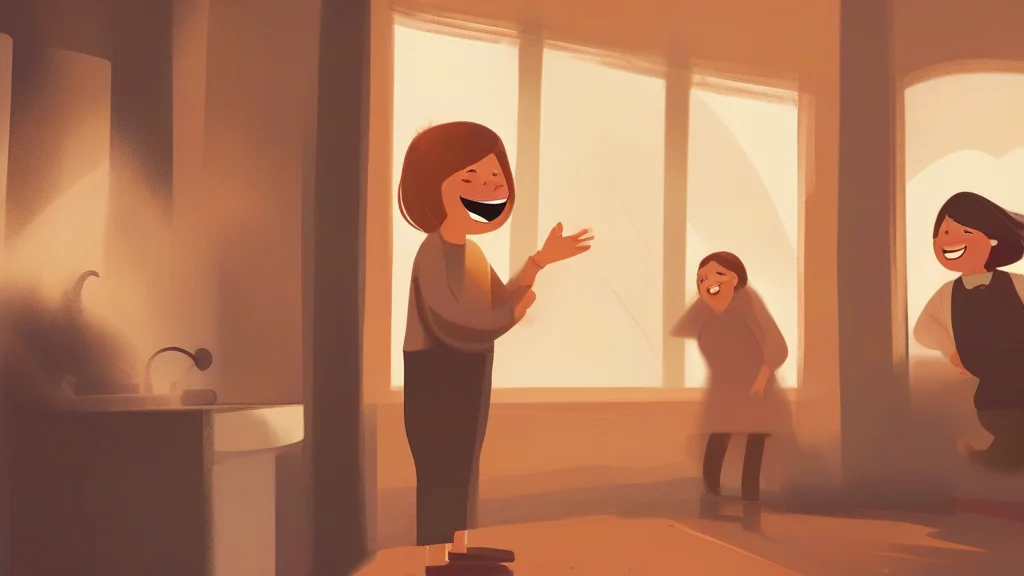
What does giggle mean?
Giggle names a brief, light, high-pitched laugh, usually heard as a short series of repeated sounds. As a verb, it describes laughing in that way, often because something is amusing, embarrassing, or unexpectedly delightful. In noun use, a giggle can be one small laugh or an uncontrollable burst of them. The word is informal but common in everyday speech and storytelling. Its tone is generally playful and affectionate rather than mocking, although adults who giggle at serious moments may be treated as immature or inappropriate. A giggle can also be deliberately suppressed, making the word useful for scenes involving nervousness, secrecy, or awkwardness. Although it belongs broadly to the family of laughter, it suggests a smaller, brighter, and more patterned sound, often with a high or childlike quality.
A short, light, high-pitched laugh, especially one occurring in a repeated series.
"A ripple of giggles spread through the audience."
Can be used for a single laugh or for an uncontrollable series of laughs.
To laugh in a short, high-pitched, often repeated way.
"She began to giggle behind her hand."
Common in informal speech and narrative writing; the laughter is often involuntary or deliberately suppressed.
Usually countable, particularly when describing a series of laughs; the singular may refer to one brief laugh.
"The room erupted in giggles."
Giggle is essentially a sound written down: its bright, clipped syllables imitate the laughter they name.
Reviewed by Deb Chak, Editor. AI-assisted content curated by RJS Tech Solutions LLP.
Where does giggle come from?
The word was recorded in the late sixteenth century, developed from a Middle English verb whose ultimate origin is uncertain. Its sound is commonly understood as imitative, reproducing the light, repeated noises of laughter, and the noun developed from the verb. No single securely established non-English cognate can be named with confidence.
Related word forms
How giggle is actually used
Informal and conversational; it can suggest youthful or childish amusement, and using it of adults in a serious setting may sound immature.
Easily confused with giggle
A giggle is typically higher-pitched and often repeated, whereas a chuckle is usually a quiet, low, restrained laugh.