
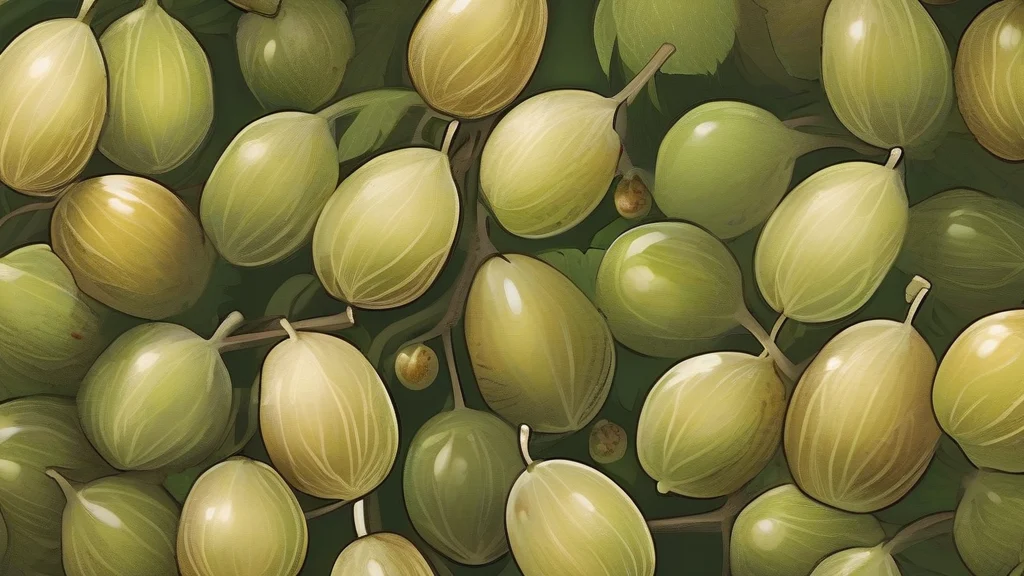
What does gooseberry mean?
Gooseberry is the common name for the tart edible fruit of thorny shrubs in the genus Ribes, especially Ribes uva-crispa. It can also denote the shrub that bears the fruit. The berries are small, firm, and usually green, although some varieties ripen to red, yellow, or almost black. Their pleasantly sharp flavour is used in jams, jellies, pies, sauces, and British desserts such as gooseberry fool. Gooseberry bushes are familiar features of traditional British kitchen gardens and are also cultivated in North America and other temperate regions. The name is traditional rather than a description of the fruit: the modern word developed from earlier forms associated with Old French, while a folk association with geese helped make the element goose prominent. Although related fruit from other Ribes species is sometimes loosely grouped with gooseberries, the term most specifically refers to the familiar prickly-berried shrub and its tart fruit.
nounA gooseberry is the small, tart fruit of a thorny shrub in the genus Ribes, especially Ribes uva-crispa. The word can also refer to the shrub that produces the fruit.
- The small, tart edible fruit of a gooseberry shrub.
- A thorny shrub of the genus Ribes that bears gooseberries, especially Ribes uva-crispa.
"She spooned sharp gooseberries into the tart before adding the sugar."
"The garden was full of gooseberry bushes heavy with pale green fruit."
"Gooseberry jam gives a wonderfully sharp flavour to a warm scone."
The standard plural adds -ies to the stressed final syllable.
"A bowl of ripe gooseberries stood on the kitchen table."
Despite its name, a gooseberry has nothing distinctly goose-like about it: it is a sharp little berry with a tangled, prickly past.
Reviewed by Deb Chak, Editor. AI-assisted content curated by RJS Tech Solutions LLP.
Where does gooseberry come from?
English gooseberry developed from Middle English forms such as goseberie, associated with Old French groseberie, whose gros element meant “large” and reflected the fruit's relative size. The word was also recast as a transparent compound of goose and berry, and the precise reason for the goose association remains uncertain. Many modern English berry names preserve this older “berry” element in compounds such as blackberry and raspberry.
Related word forms
How gooseberry is actually used
Gooseberry is familiar in British English, where it is common in preserves and puddings, but it is also well established in North American English. In culinary contexts it is distinct from a currant; the unrelated Indian gooseberry is usually called amla.
Easily confused with gooseberry
A currant is a small dried seedless grape or the fruit of certain other Ribes shrubs, whereas a gooseberry is the typically larger, prickly fruit of Ribes uva-crispa.