
What does gothic mean?
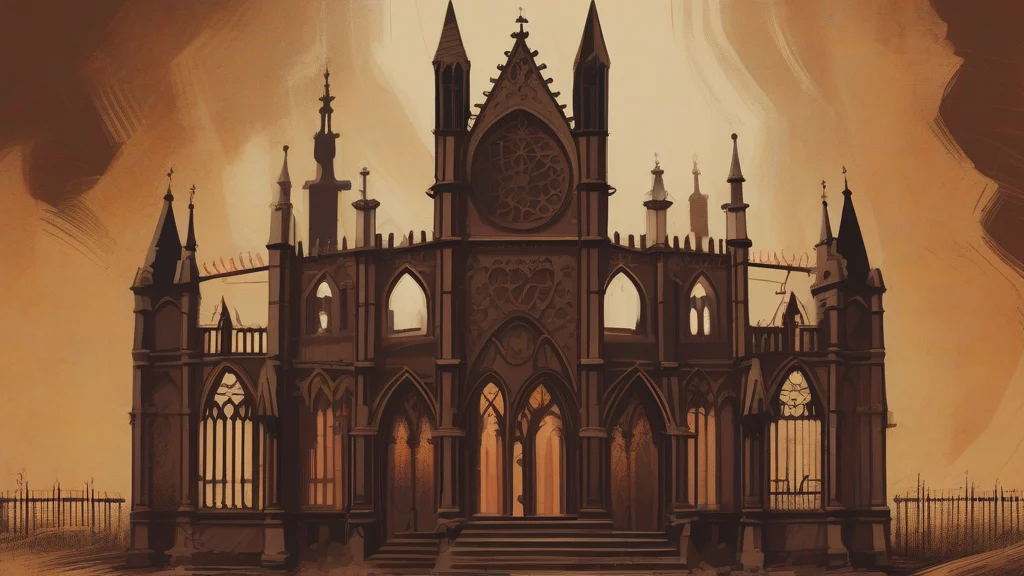
Gothic is a word with several connected meanings. Its principal historical and architectural sense refers to the medieval European style distinguished by pointed arches, ribbed vaults, flying buttresses, and elaborate decoration; it can also describe the associated ornamental script or typeface. The word originally related to the Goths, an early Germanic people, and their language. In modern literature and everyday description, however, Gothic commonly conveys a dark, eerie, ominous, or macabre atmosphere: a Gothic novel may feature ruins, mystery, violence, and supernatural dread, while a Gothic mood suggests gloom and unease. Gothic architecture and the Gothic revival are also established labels for historical styles and later revivals. Although the word can sometimes suggest something crude or barbaric, that implication is secondary to its cultural associations. Gothic is consequently useful for connecting medieval history and architecture with a broader modern vocabulary of atmosphere, style, and narrative.
Relating to the Goths or their language and culture; characteristic of medieval European architecture; resembling blackletter type; or evoking a dark, eerie, and macabre atmosphere.
"The church’s Gothic windows cast narrow bands of colored light across the stone floor."
The architectural, historical, typographic, and atmospheric meanings are distinct but often overlap. Capitalization varies with context and house style.
A member of the Goths, or collectively the medieval architectural style characterized by pointed arches, ribbed vaults, and strong vertical lines.
"The cathedral is a striking example of the Gothic."
The countable historical sense is uncommon, and Goth is normally preferred. The collective noun use “the Gothic” chiefly refers to the architectural style.
This is the regular plural in the rare countable sense meaning a member of the Goths; Goths is much more usual.
"The Roman writer’s account of the Gothics reflects the traditions of his time."
Gothic gave its name to the shadowy literary genre where decaying castles, secret passages, and unsettling atmosphere became a formula of lasting power.
Reviewed by Deb Chak, Editor. AI-assisted content curated by RJS Tech Solutions LLP.
Etymology of gothic
Gothic derives from Late Latin gothicus, from Greek gothikos, meaning “of the Goths,” and ultimately from the name Goth; the deeper origin of that name is uncertain. Early usage referred to the Goths, their language, and their culture, before the word became firmly associated with medieval architecture and the script used in medieval manuscripts. During the eighteenth century, Gothic was applied to pointed medieval architecture and its blackletter type, and the term later became central to the name of the Gothic literary genre.
Related word forms
How gothic is actually used
The standard British and American pronunciations differ in the first vowel: British English uses /ɒ/, while American English uses /ɑː/. In writing, Gothic is often capitalized when referring historically to the language, people, or a specific artistic period, but lowercase Gothic is also common for the architectural style, literary genre, and atmospheric sense. Its suggestion of barbarism or gloom is contextual rather than inherent in every use.
Easily confused with gothic
Goth usually denotes a member of the ancient Germanic people or a member of a modern subculture, whereas Gothic principally describes their language and culture, medieval architectural style, or a dark and macabre aesthetic.