
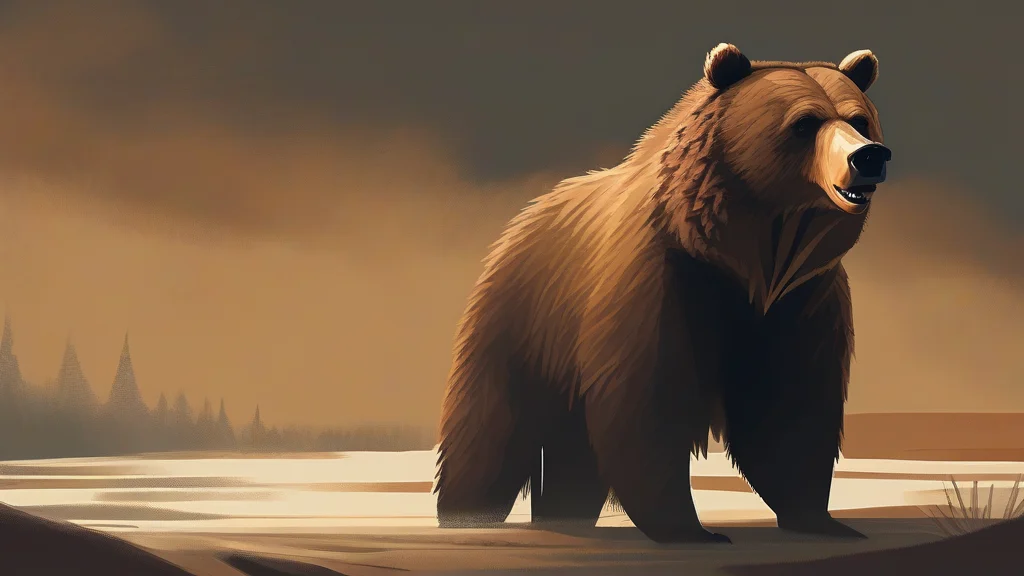
What does grizzly mean?
Grizzly most often names a large bear of the North American brown bear group, recognizable by a brown coat whose hairs are often tipped with silver or gray. In ordinary use, the name conveys both the animal’s imposing size and the fear or awe associated with encounters in the wild. It also appears in discussions of habitat, conservation, and bears in remote northern landscapes. The word has a second life as an adjective meaning grayish, gray-flecked, or relating to such a bear. Less commonly, especially in informal English, it can be a verb meaning to irritate or annoy. These senses are related historically: the animal’s name developed from “grizzled,” an older word for gray or gray-flecked, describing the mixed coloring of its fur. Thus, grizzly is useful not only as a concise name for a familiar species but also as an example of how a color word can become a specialized animal term and then a general expression of annoyance.
A large North American brown bear, traditionally distinguished by a brown coat tipped with silver or gray.
"They encountered a grizzly near the river during an unusually dry autumn."
The shortened form “grizzly” is widely established, especially in North American English.
Grayish or gray-flecked, especially with age; also meaning relating to a grizzly bear.
"The guide had a mane of grizzly hair beneath his weathered hat."
Informally, to irritate or annoy.
"His endless corrections began to grizzly everyone at the table."
This use is uncommon and has an informal, mildly comic tone.
The standard plural of the noun, used for individual bears and sometimes for the species collectively.
"Conservation teams tracked the grizzlies through the valley with GPS collars."
The name “grizzly” began as a color description: a bear whose dark coat was “grizzled” with gray.
Reviewed by Deb Chak, Editor. AI-assisted content curated by RJS Tech Solutions LLP.
Where does grizzly come from?
The modern English word dates to the early nineteenth century. It was formed from grizzled, meaning “gray” or “gray-flecked,” and was applied to a bear whose brown fur is often tipped with silver or gray. Grizzled and grizzle in turn relate to Old French gris, “gray,” from a Germanic source shared with English gray.
Related word forms
How grizzly is actually used
The noun is the established everyday use and has an outdoors-oriented, familiar tone. The adjective is relatively uncommon, while the verb is informal and much less frequent than expressions such as “annoy” or “irritate.”
Easily confused with grizzly
Grizzled describes hair or fur that is partly or entirely gray, whereas grizzly most commonly names the North American bear.
Grisly means horrifying or extremely unpleasant, while grizzly ordinarily refers to a bear, its coloring, or, informally, the act of irritating someone.