
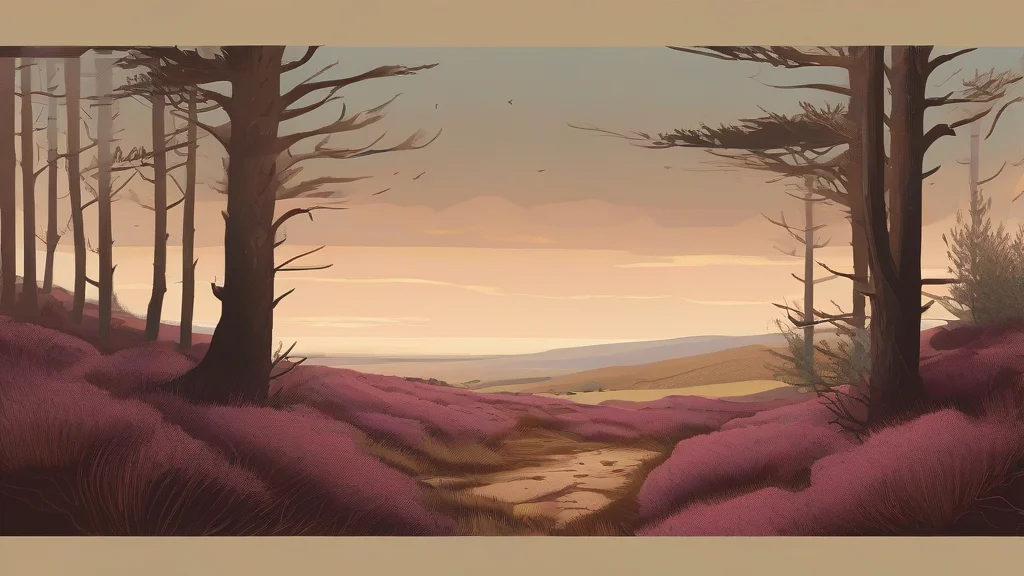
What does heathland mean?
Heathland is open, usually uncultivated land covered chiefly with heath, heather, and related grasses and shrubs. It commonly occurs on acidic, nutrient-poor soils and may support distinctive communities of plants, insects, birds, and other animals. The term can describe either the terrain itself or the habitat formed by its vegetation, so it is broader than the image of a landscape containing heather alone. Heathland is especially prominent in British English, where it frequently appears in discussions of rural landscapes, protected areas, restoration, and wildlife conservation. It can sound attractive and picturesque, but it may also connote marginal, sparsely vegetated, or ecologically fragile ground. In formal writing, the word is more precise than a general reference to “wild land,” while in less technical contexts it may simply evoke open country covered with heather and shrubs.
nounOpen, usually uncultivated land covered chiefly with heath, heather, and associated grasses or shrubs, often on acidic, nutrient-poor soil. The term can also denote this type of habitat as an ecological community.
- Land covered chiefly by heath or heather, typically forming an open, uncultivated landscape.
- An ecological habitat or community consisting of heathland vegetation and associated fauna.
"The trail crosses protected heathland where heather and gorse stretch toward the distant coast."
"Wild ponies graze on the heathland above the bay."
"Conservationists are restoring the heathland by controlling invasive shrubs and restoring native plants."
Heathland is usually uncountable. The plural is used chiefly when referring to distinct areas of the terrain.
"The reserve protects several heathlands along the western coast."
Heathland names more than a field of heather: it is the whole living landscape of low shrubs, grasses, thin soil, and the wildlife sheltered among them.
Reviewed by Deb Chak, Editor. AI-assisted content curated by RJS Tech Solutions LLP.
Where does heathland come from?
Heathland is an English compound formed from heath and land. Heath comes from Old English hǣth, used for open uncultivated land associated with heath vegetation, while land comes from Old English land, meaning ground or territory. Both elements are Germanic in origin, and related forms survive in other Germanic languages, including Dutch heide and German Heide.
How heathland is actually used
Heathland is normally used as an uncountable noun when referring to the habitat or land type. A countable plural is uncommon but can distinguish separate areas of this terrain. The word is especially associated with British landscapes and conservation, although it is also used in American English.
Easily confused with heathland
Heath can refer either to the low vegetation itself or to an area covered by it, whereas heathland primarily identifies the land, habitat, or landscape characterized by that vegetation.