
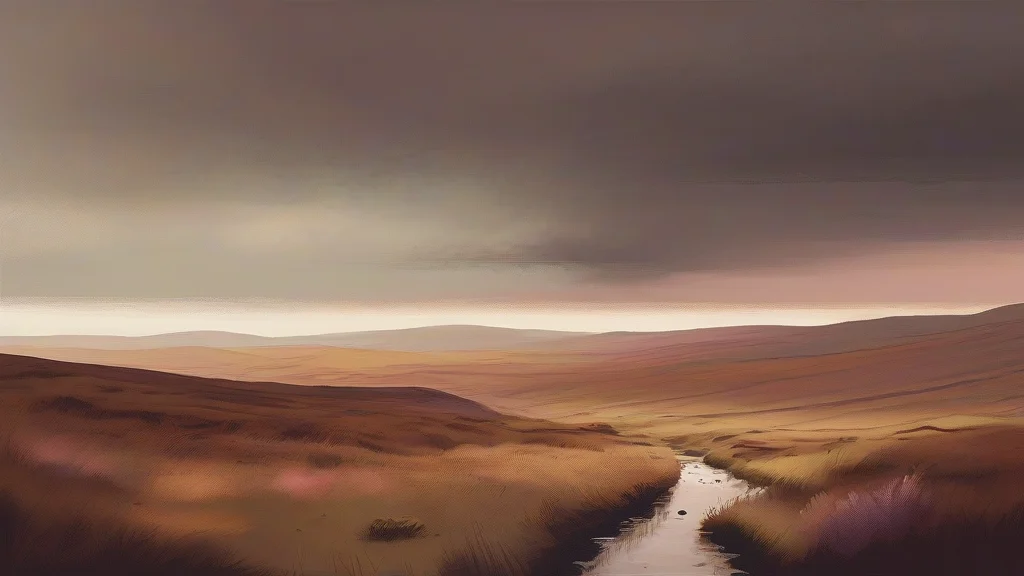
What does moorland mean?
Moorland means open, uncultivated upland, especially in the characteristic landscape of the British Isles, where heather, coarse grasses, peat, and exposed rock are common. The word often emphasizes both the natural vegetation and the broad, open character of the terrain: one can speak of remote, windswept, or bleak moorland. It is most familiar in British English, though it is also understood and occasionally used in North America and other English-speaking regions. In British usage, a moor is a particular area of such land, while moorland names the type of landscape or the broader expanse formed by it. The term is often associated with sparsely populated uplands, tough conditions, hiking, and conservation, although it does not necessarily imply that the land is wet. In British usage, a moor is a particular area of such land, while moorland names the type of landscape or the broader expanse formed by it. The term is often associated with sparsely populated uplands, tough conditions, hiking, and conservation, although it does not necessarily imply that the land is wet.
nounAn area of open, uncultivated upland typically covered with grasses, heather, or other low vegetation. The term often describes a broad landscape rather than a single distinct feature.
- Open or uncultivated upland, especially land covered with heather, grasses, or similar vegetation.
"Wild ponies graze across the open moorland under a blanket of low cloud."
"The path crosses miles of open moorland, with few signs of human settlement."
"Rare birds use the upland moorland as a breeding habitat."
The plural is uncommon; the singular is normally used collectively for a landscape or region.
"The study compared the plant communities of several northern moorlands."
In its traditional British sense, moorland is not a wetland: it is the windswept, heather-covered upland that gave the word moor its modern form.
Reviewed by Deb Chak, Editor. AI-assisted content curated by RJS Tech Solutions LLP.
Where does moorland come from?
Moorland was formed within English by combining moor and land. The word moor ultimately comes from Old English mōr, meaning open uncultivated land or a tract of such country, while land has its own Germanic ancestry. The compound became established in the modern period for describing broad areas of upland terrain, particularly in Britain.
How moorland is actually used
The word is especially common in British English, where it is often used in a geographical or ecological context. It normally denotes the general character of a landscape rather than a single tract of land.
Easily confused with moorland
A moor is the open land itself, whereas moorland is a collective noun emphasizing a broad area or landscape of such terrain.