
What does imp mean?
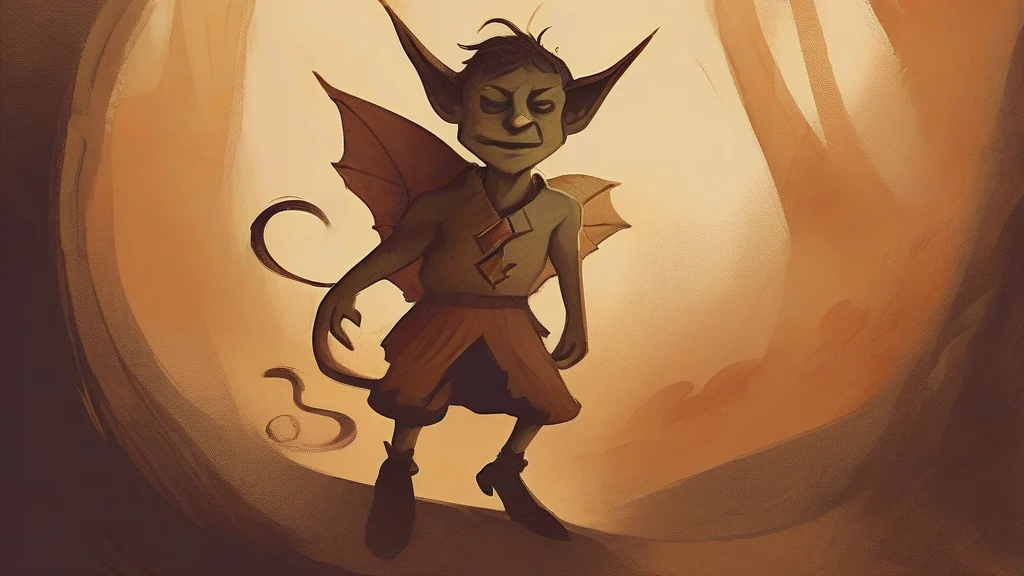
An imp is a small, mischievous creature from folklore, commonly imagined as a goblin, demon, or minor devil. The word can also describe a person whose behaviour is naughty, cunning, or mildly malicious. “Imp” has a playful literary quality, so it is often used in stories, poems, and humorous descriptions rather than in formal discussion. Its figurative use can be affectionate when referring to a child or fond insult when referring to an adult troublemaker. The word is recognizable in both British and American English, although individual literary uses may differ. Although the basic meaning concerns a supernatural creature, the modern sense extends comfortably to human behaviour: someone may be called an imp for causing small difficulties, making jokes at others’ expense, or behaving mischievously. The related adjective “impish” emphasizes the playful, cheeky side of the word rather than a genuinely frightening supernatural nature.
A small, mischievous or malevolent creature of folklore, especially a demon, goblin, or devil; by extension, a mischievous or contemptible person.
"A tiny imp appeared at the window and vanished when the moon came out."
Commonly used in folklore, fantasy, and figurative descriptions of mischievous people.
To insert or graft something into another organism or structure.
"The specialist imp the feather into the bird's wing."
This is an uncommon technical or archaic usage, largely confined to specialized contexts.
The regular plural is “imps”; in folklore, it refers to multiple mischievous spirits or demons.
"The tiny imps filled the room with whispers and overturned lamps."
From folklore to insult, an imp can mean either a tiny supernatural troublemaker or the human mischiefmaker who earns the nickname.
Reviewed by Deb Chak, Editor. AI-assisted content curated by RJS Tech Solutions LLP.
Where does imp come from?
The word comes from Old English “impa,” meaning a sprite or demon, and ultimately belongs to a Germanic family of words connected with small, mischievous creatures. It continued in Middle English and was used in folklore for devils and goblins. The modern figurative sense, referring to a mischievous person, developed from the creature’s traditional behaviour. Cognates and related forms appear in other Germanic languages, while the derivative “impish” retains the word’s characteristic association with playful mischief.
Related word forms
How imp is actually used
The noun is strongly associated with folklore and supernatural folklore. In modern figurative use, it is usually humorous or contemptuous, especially when describing a child or a mischievous adult.