
What does joust mean?
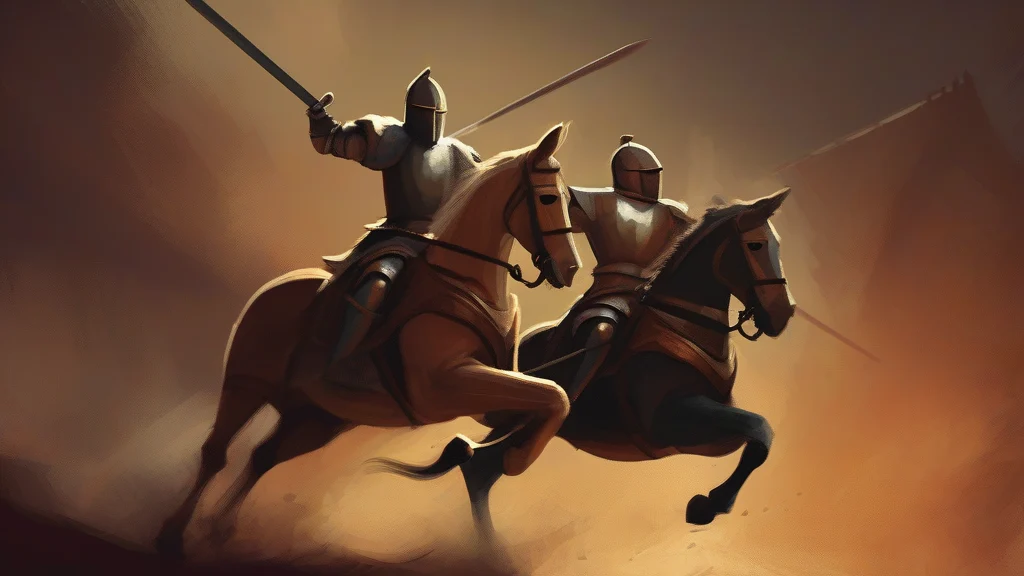
To joust is to take part in a mounted contest, traditionally between two riders carrying lances and aiming either to strike an opponent or break the opponent's lance. As a noun, a joust is the contest or encounter itself. The term comes chiefly from the tournament culture of medieval Europe, where jousting combined military training, aristocratic display, pageantry, and spectacle. It remains common in historical fiction, reenactments, museums, and accounts of medieval festivals. Although the original activity was dangerous, modern ceremonial versions commonly use armour and specially designed blunt or padded lances. Figurative uses are possible, as when two teams are described as jousting for a title, but such language tends to sound deliberately archaic or theatrical. For most modern speakers, the word’s principal value is its strong association with knights, lances, armour, and the age of chivalry.
To compete in a mounted contest, usually by charging at an opponent with a lance.
"The knights jousted at the centre of the tournament field."
Usually appears in historical, ceremonial, or figurative contexts.
A formal mounted contest between riders, especially one in which competitors use lances.
"The king watched the final joust from the stands."
A joust was a central event in the medieval tournament, although the term may also refer to a staged historical reenactment.
The plural refers to individual jousting contests or encounters.
"The tournament featured several jousts across the afternoon."
What began as a judicial contest involving blunt, carefully controlled lances became one of the defining spectacles of medieval tournament culture.
Reviewed by Deb Chak, Editor. AI-assisted content curated by RJS Tech Solutions LLP.
Where does joust come from?
The word comes through Middle English from Old French juster, meaning “to joust.” The French verb derives from Medieval Latin justitiare, a term associated with deciding disputes through judicial combat. This in turn connects with Latin iustitia, “justice,” ultimately from iustus, “just,” making joust a historical relative of words such as justice, justify, and adjust.
Related word forms
How joust is actually used
The word is chiefly associated with historical or ceremonial jousting. In modern figurative use, it can suggest two people or organizations confronting one another in a direct contest, but this usage is less common than the historical sense.
Easily confused with joust
To joust is to compete in a formal mounted contest, whereas to jostle is to push, crowd, or move roughly in a busy space.