
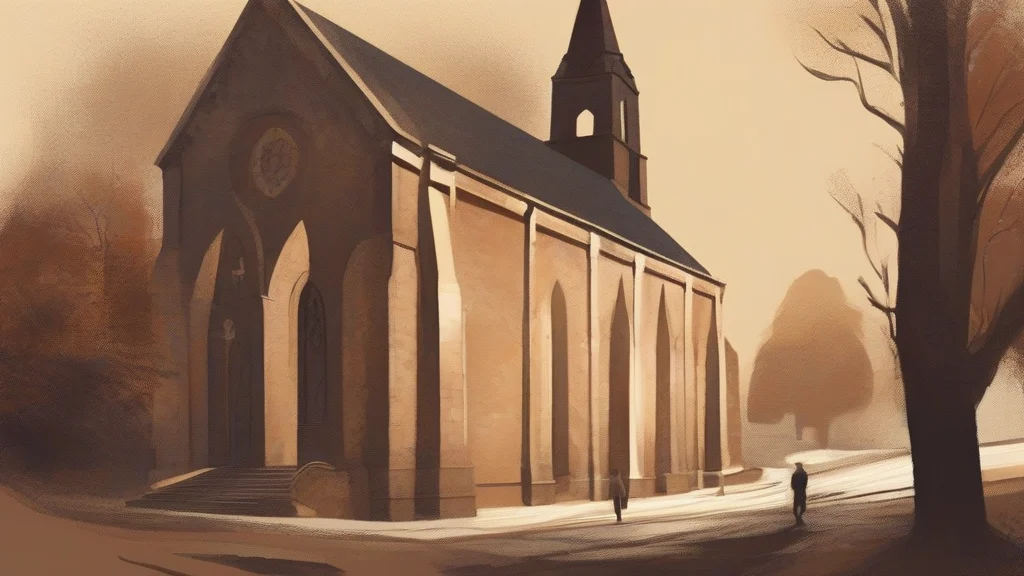
What does kirk mean?
Kirk is a chiefly Scottish noun meaning a church, especially a parish church or the building in which a congregation worships. It is the traditional Scots counterpart of the more geographically neutral word church and is also heard in Scots-speaking communities beyond Scotland, including parts of Northern England. The capitalized expression “the Kirk” has a more specific institutional meaning: the Church of Scotland, a Presbyterian church. In writing, kirk often conveys local, traditional, or rural associations more strongly than church, but it is not a spelling error in Scottish contexts. Outside Scotland it may sound deliberately regional or may identify a building by its local name. The word is especially useful when reading Scottish literature, historical texts, and place names, where it preserves a distinct vernacular vocabulary rather than merely representing a stylistic variant. Its Norse ancestry also makes it an accessible example of how Scandinavian contact shaped medieval and early modern English.
nounChiefly Scottish: a church, especially a parish church or place of Christian worship. Capitalized as “the Kirk,” it can also denote the Church of Scotland as an institution.
- A church or place of Christian worship, especially a parish church in Scotland.
- The Church of Scotland as an institution, conventionally capitalized as “the Kirk.”
"On the islands, the old kirk stands above the harbor with its walls weathered by generations of Atlantic storms."
"For generations, families in the parish had gathered for worship in the kirk."
"The Kirk has long been regarded as the national church of Scotland."
The plural is grammatically regular but relatively uncommon because kirk is frequently used attributively or with an article.
"Several small kirks serve the scattered communities of the northern islands."
In Scotland, “the Kirk” names not merely a building but the Presbyterian Church of Scotland itself.
Reviewed by Deb Chak, Editor. AI-assisted content curated by RJS Tech Solutions LLP.
Where does kirk come from?
Modern kirk developed in Scots from Old Norse kirkja, which in turn came from Old English cyrce. Old English cyrce was borrowed from Latin ecclesia, a Latinized form of Greek ekklēsia, meaning “assembly” and referring to a gathered congregation or church. The related English word church follows a parallel historical path through Old English.
Related word forms
How kirk is actually used
The uncapitalized word ordinarily refers to a church building, especially in Scottish and Northern English usage. Outside Scotland, it may sound deliberately Scots or may be used as the local name of a particular church.