
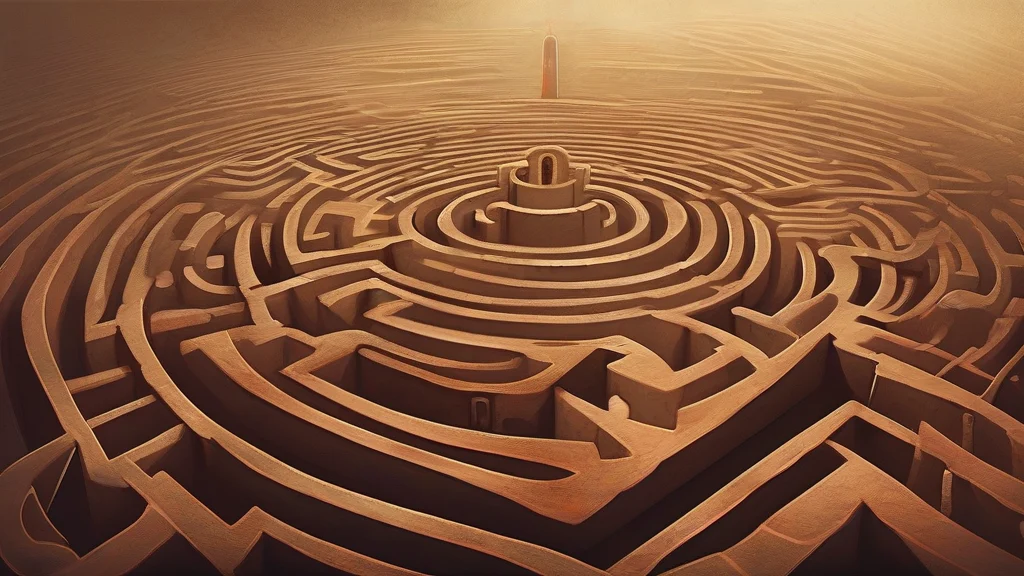
What does labyrinthian mean?
Labyrinthian describes something that resembles a maze, with complicated passages and numerous possible directions. It can refer to physical spaces, such as a network of winding corridors, but it is also used metaphorically for organizations, systems, and arguments whose relationships or procedures are difficult to understand. The adjective conveys not merely complexity but a sense of disorientation: a labyrinthian structure may be elaborate and crowded enough to make a person lose their way or fail to see the straightforward route. It is more common in formal and literary writing than in everyday speech. Although labyrinthine is the more frequently used modern variant, labyrinthian remains a recognized adjective and can sound especially traditional or rhetorical. The word evokes the ancient Greek labyrinth, a legendary maze associated with Daedalus, Minotaur, and Theseus, and has therefore long carried associations with mystery, danger, and eventual discovery.
adjectiveResembling a labyrinth; consisting of intricate, confusing passages. Also used figuratively to describe something highly complex and difficult to navigate.
- Having many complicated, confusing passages, like a maze.
- Extremely intricate or difficult to understand or navigate, especially as an abstract quality.
"The researchers followed a labyrinthian network of underground tunnels."
"The old city was threaded by labyrinthian streets that were easy to get lost in."
"The proposal led to a labyrinthian series of negotiations among competing departments."
The word leads back to the Greek labyrinth, the maze whose solution required Theseus to follow a thread through its twisting passages.
Reviewed by Deb Chak, Editor. AI-assisted content curated by RJS Tech Solutions LLP.
Where does labyrinthian come from?
Labyrinthian derives from Latin labyrinthinus, an adjective meaning “pertaining to a labyrinth.” The Latin word came from Greek labyrinthos, referring to the intricate maze in Greek mythology, traditionally associated with Daedalus and the Minotaur. English borrowed forms of the word in the medieval period, and the modern adjectival family developed from that inherited Latin and Greek vocabulary.
Related word forms
How labyrinthian is actually used
Labyrinthian is formal and literary in tone. Labyrinthine is more common in contemporary writing, though both are accepted.
Easily confused with labyrinthian
Both are adjectives meaning maze-like or intricately complex, but labyrinthine is the more usual modern form, while labyrinthian is a less common variant.