
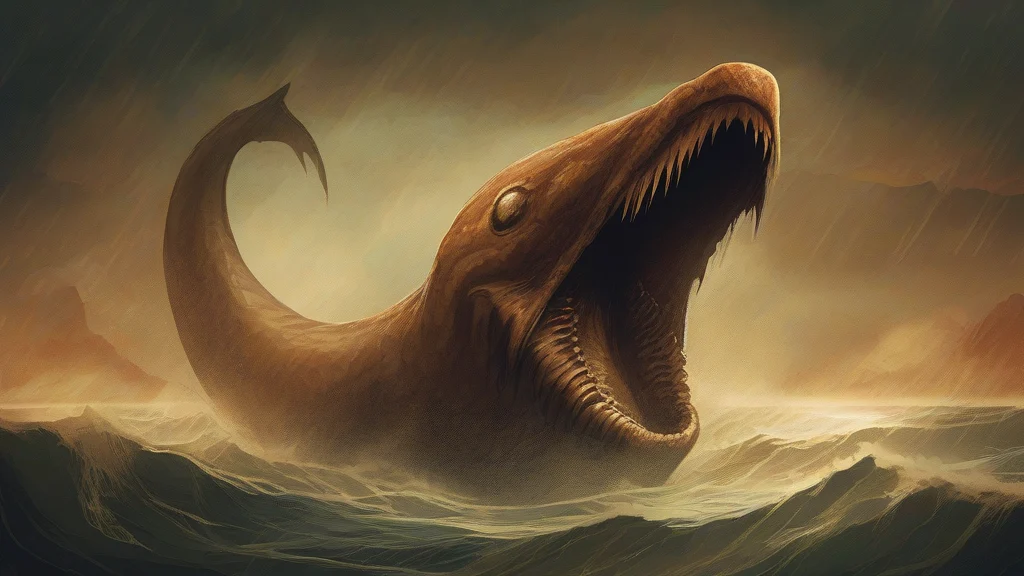
What does leviathan mean?
Leviathan denotes something vastly powerful and difficult to oppose. Its best-known reference is to the gigantic sea creature described in the Book of Job, where it symbolizes immensity, strength, and perhaps humanity’s limited ability to comprehend nature. Modern writers frequently use the term for a dominant corporation, government, political establishment, or other formidable institution. The expression has a largely negative tone: it suggests power that is concentrated, resistant to control, and potentially threatening. Its biblical associations give it a sense of antiquity and moral weight, while its metaphorical use has a distinguished history in political philosophy, especially through Thomas Hobbes’s comparison of a powerful state to a Leviathan. The word is therefore useful when describing formidable power in vivid, memorable, and culturally resonant terms.
nounA gigantic sea creature, especially the powerful monster described in the Book of Job. By extension, the word refers to an overwhelmingly powerful person, organization, or state.
- A huge or formidable creature, especially the sea monster named in the Book of Job.
- A person, organization, institution, or state possessing overwhelming power or influence.
"The young journalist had the courage to challenge the Leviathan of the country's political establishment."
"Many observers regarded the expanding corporation as an economic Leviathan."
"In the Book of Job, Leviathan is described as a creature whose power and strength are incomparable."
The plural is used for multiple enormously powerful people, organizations, creatures, or states.
"The two media companies had become leviathans with influence extending across several countries."
From a terrifying biblical sea monster to a nickname for the modern state, the Leviathan has always symbolized power too immense to ignore.
Reviewed by Deb Chak, Editor. AI-assisted content curated by RJS Tech Solutions LLP.
Where does leviathan come from?
The English word comes through Greek and Latin from Hebrew livyatan, the name of the great sea creature in the Book of Job. The precise derivation of the Hebrew form is uncertain, although proposals have connected it with a root associated with joining, breaking, or twisting. Greek writers used the term for a huge sea monster, and Latin adopted it as leviathan. English later extended the word metaphorically to powerful persons, institutions, and states.
How leviathan is actually used
The word is literary and often carries a negative connotation, suggesting intimidating or unchecked power. It is frequently capitalized when referring specifically to the biblical creature and is also commonly capitalized in the political and philosophical senses.
Easily confused with leviathan
Leviathan is usually a sea creature and a metaphor for concentrated power, whereas behemoth is primarily a gigantic land creature in the Book of Job and is also used figuratively for something immense.