
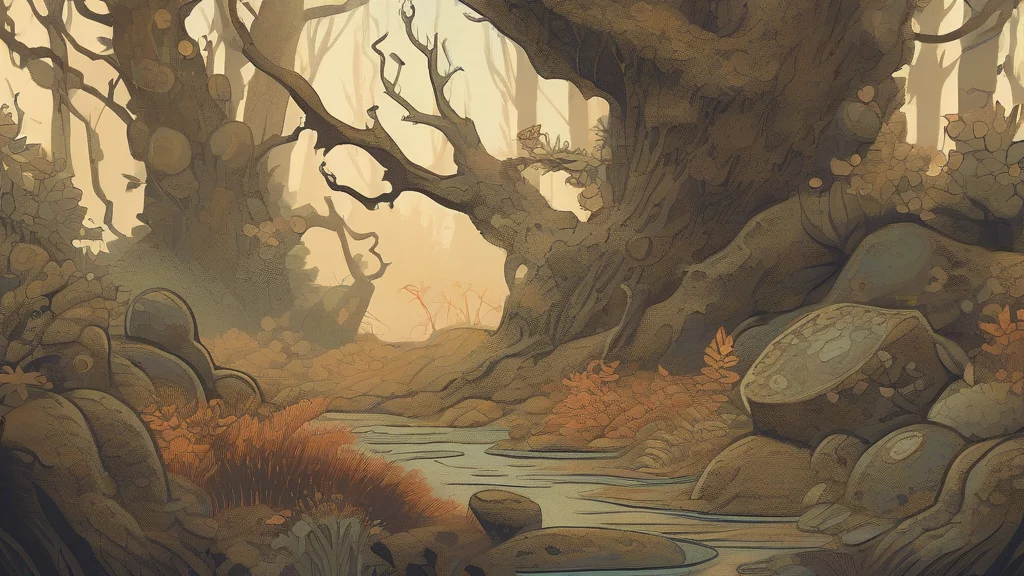
What does lichened mean?
Lichened describes something covered with lichen, a group of small organisms that commonly grow on rock, bark, stone, and other exposed surfaces. The word is especially evocative when applied to old buildings, monuments, gravestones, trees, or weathered stone, since lichen gradually spreads across such materials and creates mottled patterns of grey, green, yellow, or orange. It is more specific than mossy: moss refers primarily to particular nonvascular plants, while lichen refers to a distinct partnership between a fungus and an alga or cyanobacterium. In ordinary speech, “lichened” often carries a sense of age, endurance, and natural weathering. Although it can sound picturesque or literary, it is precise and evocative in descriptions of landscapes, architecture, and outdoor objects.
Covered with, overgrown by, or marked with lichen.
"The lichened façade had become almost completely hidden beneath pale growths."
Often used for weathered natural or architectural surfaces; the word can imply age and prolonged exposure.
Covered with or overgrown by lichen.
"After decades of neglect, the lower stones were lichened by damp and shade."
This is the past tense and past participle of the rare verb lichen and is much less common than the adjective use.
A lichened wall wears a slow-moving map of tiny organisms that have been colonizing its surface for years.
Reviewed by Deb Chak, Editor. AI-assisted content curated by RJS Tech Solutions LLP.
Where does lichened come from?
The adjective is formed from the English noun lichen, which entered English from Latin lichen. Latin lichen comes from the Greek leichēn, meaning “tree moss,” and is related to the verb leichein, “to lick.” The English noun lichen was established by the early 16th century; the suffix -ed was later added to form the descriptive participial adjective lichened.
How lichened is actually used
Lichened is descriptive and somewhat literary. It is usually used for natural surfaces, stone, bark, walls, or monuments, and suggests age, weathering, or prolonged exposure.
Easily confused with lichened
Lichened specifically indicates that lichen is growing on or marking something, whereas mossy more generally means covered with moss.