
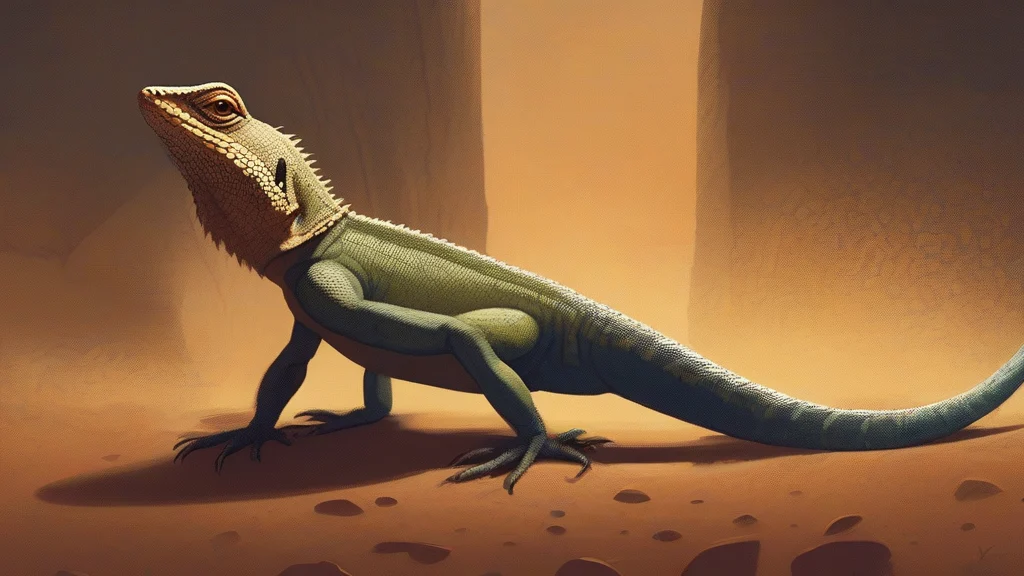
What does lizard mean?
A lizard is a reptile belonging to the group Lacertilia, the group that includes geckos, iguanas, skinks, chameleons, and monitor lizards. Most have four legs, a long tail, dry scaly skin, and breathe with lungs; they generally reproduce by laying eggs, although some species give birth to live young. Lizards are found worldwide, with especially high diversity in warm and tropical regions. They may live on the ground, in trees, underground, or on rocks, and many eat insects while larger species consume plants or other animals. The word can occasionally be used informally to describe a cowardly person, though its everyday meaning is zoological. Its usefulness as a vocabulary word is partly taxonomic: “lizard” names a clearly recognizable reptile group while also serving as an accessible example of the diversity of reptilian life.
nounA lizard is a reptile with a long body, four legs, and a tail, typically living on land. Lizards include groups such as geckos, iguanas, skinks, and monitor lizards.
- A reptile of the group Lacertilia, characterized by a scaly body, four legs, and a tail.
"A small green lizard basked on the warm garden wall."
"The lizard disappeared into a crack in the stone wall."
"Her research focuses on the behaviour of desert lizards in extreme heat."
The standard plural is formed by adding -s.
"Several lizards sunned themselves on the rocks."
Some lizards can detach their tails when threatened, and many can grow replacement tails.
Reviewed by Deb Chak, Editor. AI-assisted content curated by RJS Tech Solutions LLP.
Etymology of lizard
The English word comes through Middle English from Old French lézard, which ultimately derives from Latin lacerta, a word referring to the lizard and also used for the constellation commonly called the Lizard. The Latin root underlies scientific terms such as lacertid, referring to a member of the lizard group, and lacertine, meaning lizard-like or of lizards. English has preserved the basic meaning while the separate zoological group formerly called Lacertilia was established through modern classification.
How lizard is actually used
In ordinary modern English, the term is general rather than restricted to a particular species. In some informal or older usages, the word can refer disparagingly to a timid or cowardly person, but this sense is uncommon and context-dependent.
Easily confused with lizard
A lizard is a reptile, whereas a salamander is an amphibian whose larvae usually develop in water.