
What does lute mean?
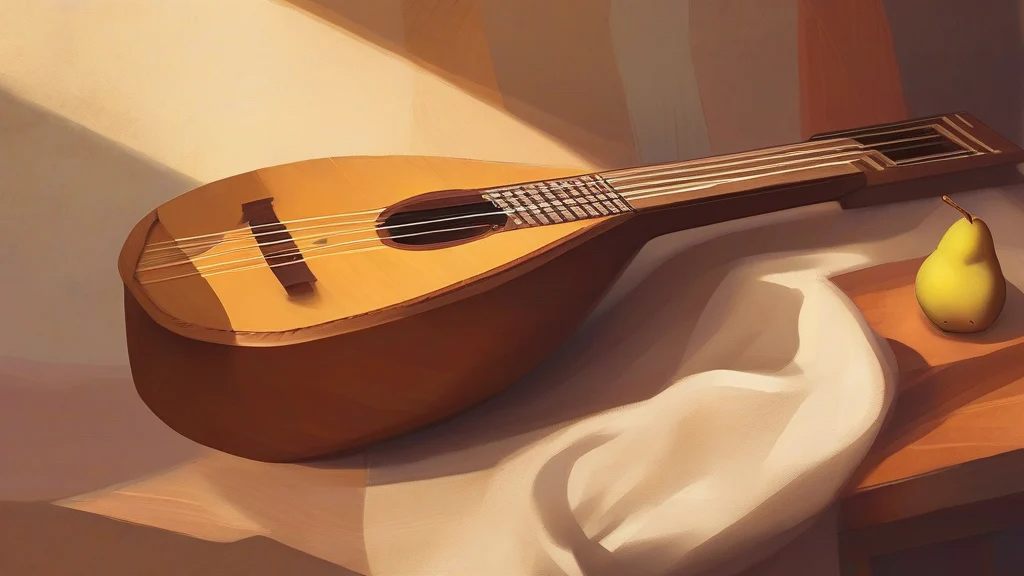
A lute is a plucked string instrument with a hollow, usually pear-shaped body and a fretted neck. Its strings are often tuned in courses, allowing pairs of strings to sound together, and players traditionally use their fingers or a small plectrum. The lute became especially prominent in medieval and Renaissance Europe, where it was used for courtly music, dance, song, and accompaniment. It later declined in competition with keyboard instruments but continued in some European traditions and in other forms in the Middle East and North Africa. The modern word also occurs in historical and poetic contexts, where it may refer more broadly to a lyre or another early stringed instrument. Its name reflects the instrument’s construction: English lute came through Old French and Medieval Latin from Arabic al-ʿūd, commonly interpreted as “the wood” because of the wooden soundbox. The familiar oud belongs to a closely related musical tradition.
nounA stringed musical instrument with a hollow, typically pear-shaped body and a fretted neck, traditionally plucked with the fingers or a plectrum. It was especially important in European music from the Middle Ages through the Renaissance.
- A plucked string instrument with a hollow body, fretted neck, and strings running along the soundboard.
- Archaically, a poetical or historical name for a lyre or similar stringed instrument.
"A musician played the lute softly as the evening audience gathered."
"The performer accompanied her song on a lute."
"A portrait of the musician shows him holding an elaborately decorated lute."
Usually countable; the plural refers to multiple instruments or to different types or makers of the instrument.
"The collection includes several lutes made in Italy during the sixteenth century."
The word lute comes from Arabic al-ʿūd, meaning “the wood,” a reference to the instrument’s wooden soundbox.
Reviewed by Deb Chak, Editor. AI-assisted content curated by RJS Tech Solutions LLP.
Where does lute come from?
English lute came through Old French lut and Medieval Latin lūt from Arabic al-ʿūd, “the wood,” a name associated with the instrument’s wooden body. The Arabic designation is also the source of the English word oud. The lute became a major instrument in medieval and Renaissance European music before being displaced in many settings by the keyboard and other newer instruments.
How lute is actually used
In modern use, the term most often refers to the historical European instrument, although the closely related oud remains in use today. The older sense survives mainly in poetry, historical writing, and descriptions of traditional music.
Easily confused with lute
A lute is a musical instrument, whereas loot is goods taken by theft.