
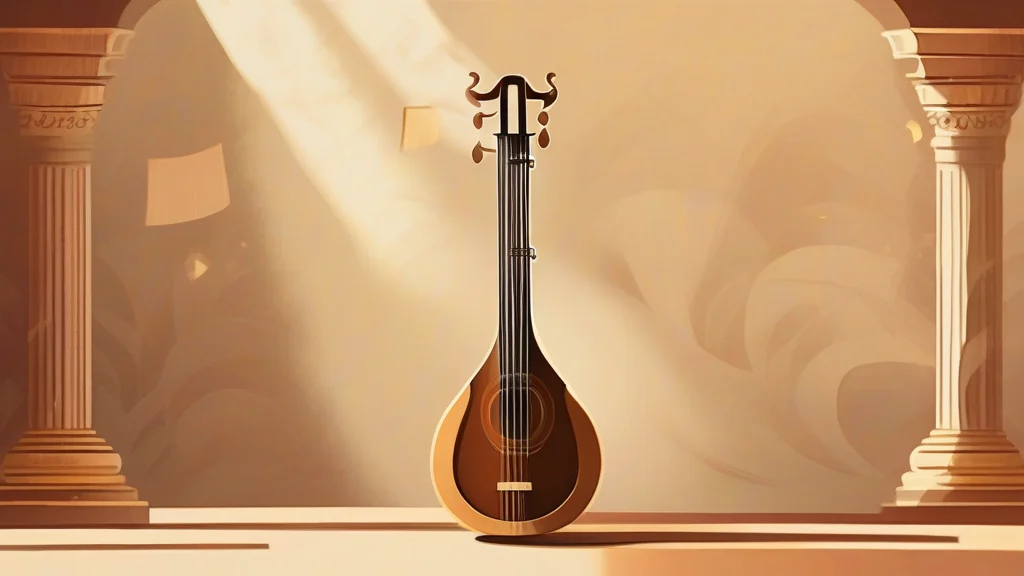
What does lyre mean?
A lyre is an ancient stringed instrument, best known from Greek culture and literature, with a hollow soundbox, two curved arms, and a crossbar holding the strings. In Greek art and mythology, it is closely associated with poets, musicians, and figures such as Orpheus. The word now often appears in museum descriptions, classical music, and modern references to replica instruments. Its historical importance extends beyond music: the term lyric comes from the Greek tradition of singing poetry to a lyre, so the instrument helped give lyric poetry its name. A lyre differs from a modern harp in its compact frame and simpler construction. Although largely replaced by later instruments, it remains an important symbol of classical antiquity and of the poetic idea of music accompanying verse.
nounAn ancient stringed instrument with a hollow, U-shaped soundbox and two curved arms connected by a crossbar, across which the strings were stretched. The lyre was especially associated with ancient Greece and was commonly used in poetry, music, and ceremonial contexts.
- An ancient stringed instrument with a U-shaped frame and a crossbar supporting the strings, associated especially with Greek and Near Eastern musical traditions.
- A modern decorative or performance instrument modeled on the ancient Greek lyre.
"The poet accompanied his recitation on a lyre."
"The museum displays a replica of a lyre beside a painted Greek vase."
"She played a gentle melody on her lyre during the ceremony."
The plural refers to multiple lyre instruments.
"The display includes two lyres recovered from an ancient settlement."
The ancient lyre gave its name to lyric poetry: a lyric was originally a song performed with this instrument.
Reviewed by Deb Chak, Editor. AI-assisted content curated by RJS Tech Solutions LLP.
Where does lyre come from?
The English word comes through Latin lyra from Ancient Greek λύρα (lýra), the name of the instrument. Greek poetic tradition used the lyre as an accompaniment to sung verse, and the related Greek adjective lyrikós, meaning “of a lyre,” developed into terms such as lyric and lyrical. The instrument itself was influential across ancient Mediterranean cultures, although the precise details of its musical construction varied.
How lyre is actually used
The word is primarily historical, literary, or cultural in modern English. It may refer broadly to an ancient lyre or specifically to a modern reconstruction modeled on one.
Easily confused with lyre
A lyre has a compact U-shaped frame with a crossbar, whereas a harp typically has a tall triangular frame and a larger set of strings.