
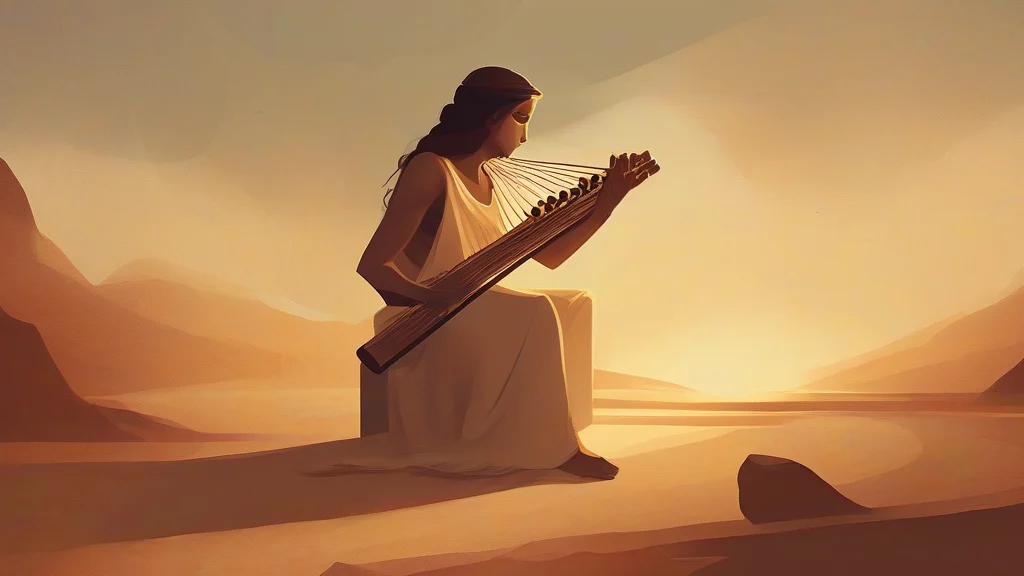
What does kithara mean?
A kithara was a principal stringed instrument of ancient Greece, especially important in the accompaniment of poetry, song, and ceremonial or public performance. It had a hollow wooden body and a neck on which the strings could be stopped, making it more elaborate than simpler plucked instruments such as the lyre. Depictions in ancient sculpture and painted pottery show kitharists performing with the instrument held upright, sometimes with a plectrum or a strap supporting its weight. The term also survives in the related name “kitharist,” meaning a player of the instrument, and in the ultimate ancestry of “guitar.” Today, “kithara” is chiefly encountered in classical history, literature, art history, and discussions of ancient Greek music. It should not be used as a simple synonym for every kind of harp or lute, because the kithara had a distinctive body-and-neck construction and a defined role in Greek musical culture.
nounAn ancient Greek stringed instrument with a hollow wooden body and a fretted neck, played by plucking or strumming. It was a principal instrument in the music of classical Greece.
- An ancient Greek stringed instrument with a hollow body, fretted neck, and strings plucked or strummed with a plectrum or fingers.
"The musician drew his fingers across the strings of the kithara as the audience gathered around."
"Apollo and the Muses are often shown in ancient art with a kithara."
"The performer adjusted the tuning of the kithara before the competition began."
The regular English plural is “kitharas”; the historical Greek form kitharai may occur in specialized writing.
"Several finely decorated kitharas have been preserved in museums."
The kithara gave ancient Greek music its name: the same Greek root survives in the word “guitar” and in the name of a player, the kitharist.
Reviewed by Deb Chak, Editor. AI-assisted content curated by RJS Tech Solutions LLP.
Where does kithara come from?
The English word comes through Latin cithara from Ancient Greek kithára, the name of a stringed instrument. The Greek form is also preserved in the modern spelling kithara, while kitharist derives from the Greek word for an instrument-player. Guitar is a more distant cognate, transmitted through Latin and Spanish forms ultimately associated with the same Greek name.
Related word forms
How kithara is actually used
The word belongs primarily to historical, classical, and archaeological discussion. It is also used figuratively in modern writing for an instrument associated with the public and ceremonial music of ancient Greece.
Easily confused with kithara
Cithara is the Latinized spelling of the same ancient Greek instrument name, while kithara reflects the Greek form more directly.
A lyre has a rounded, yoke-shaped frame with strings running between the arms and a crossbar, whereas a kithara has a broad, box-like sound box and a fretted neck.