What does cithara mean?
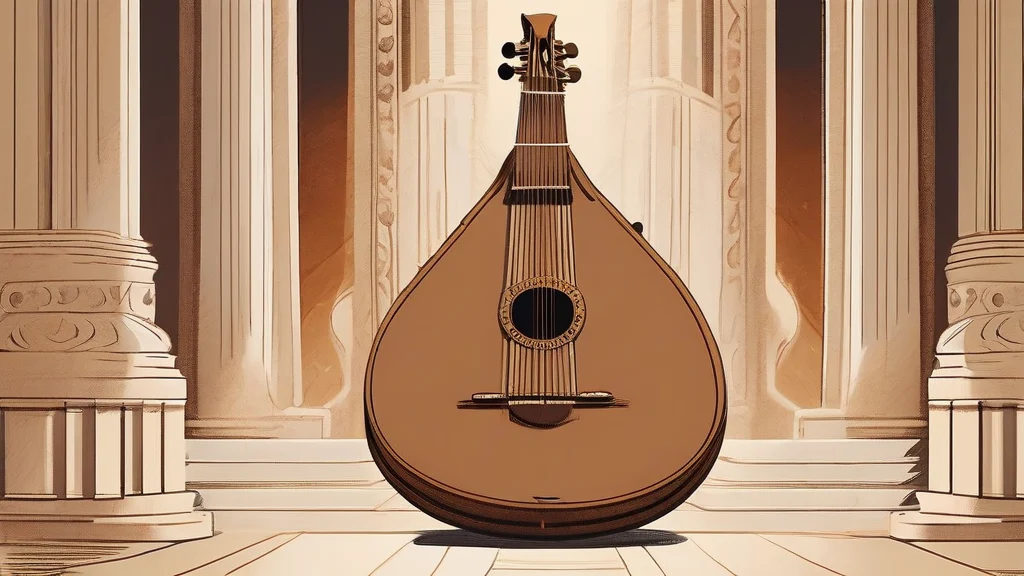
The cithara was the premier stringed instrument of ancient Greece and Rome — a large, elaborately constructed member of the lyre family, distinguished from the lighter amateur lyre by its substantial wooden soundbox, ornate arms, and greater number of strings. Held upright against the body, it was struck with a plectrum and demanded real virtuosity, so it belonged to professional musicians who performed at religious festivals, public competitions such as the Pythian Games, and private banquets. Poets and mythographers made it the emblem of refined artistry, associating it above all with Apollo, god of music. Though the instrument itself fell silent centuries ago, the word survives as a technical term in musicology, archaeology, and classical studies. Its legacy also lives on linguistically: through Greek kithara and Latin cithara descend not only the German zither and the Renaissance cittern but, by a long route through Arabic and Spanish, the modern guitar — making this ancient word a direct ancestor of one of today's most popular instruments.
nounAn ancient Greek and Roman stringed musical instrument resembling a lyre but larger and more elaborate, with a wooden soundbox, played with a plectrum by professional musicians.
- The ancient Greek and Roman professional concert lyre, a large wooden stringed instrument played with a plectrum.
"The vase painting shows a musician cradling a cithara, its strings glinting in the torchlight."
"Contestants at the Pythian Games were judged on their skill with the cithara as well as the flute."
"In classical statuary, Apollo is often depicted holding a cithara rather than the simpler tortoiseshell lyre."
The anglicized plural 'citharas' is standard in modern English; the Latinate plural 'citharae' occasionally appears in scholarly writing.
"The museum's new gallery displays two reconstructed citharas alongside fragments of original instruments."
The humble guitar traces its family tree straight back to Apollo's cithara — same word, three thousand years apart.
Reviewed by Deb Chak, Editor. AI-assisted content curated by RJS Tech Solutions LLP.
Etymology of cithara
The word derives from Greek kithára (κιθάρα), the name of the professional concert lyre, which Latin borrowed as cithara and passed into Old English and other European languages. The Greek term itself may be related to Persian sihtar, the ancestor of 'sithe'. From the same root come zither (via German), the medieval citole and cittern, and ultimately the guitar, whose name travelled through Arabic al-qīthārah and Spanish guitarra. English adopted the form 'cithara' in the early modern period largely through learned Latin usage.
Related word forms
How cithara is actually used
The word is scholarly and rare outside discussions of archaeology, music history, and classics; it appears mainly in academic writing, museum catalogues, and historical fiction. The plural forms 'citharas' and the Latin-style 'citharae' are both found, though the anglicized plural is now more common.
Easily confused with cithara
A cithara is a larger, heavier concert instrument with a wooden soundbox played by professionals, while the smaller, lighter lyre was the amateur's instrument of ancient Greece.
A cittern is a later Renaissance fretted, plucked instrument descended distantly from the same Greek root, whereas the cithara is the ancient unfretted lyre-like instrument itself.