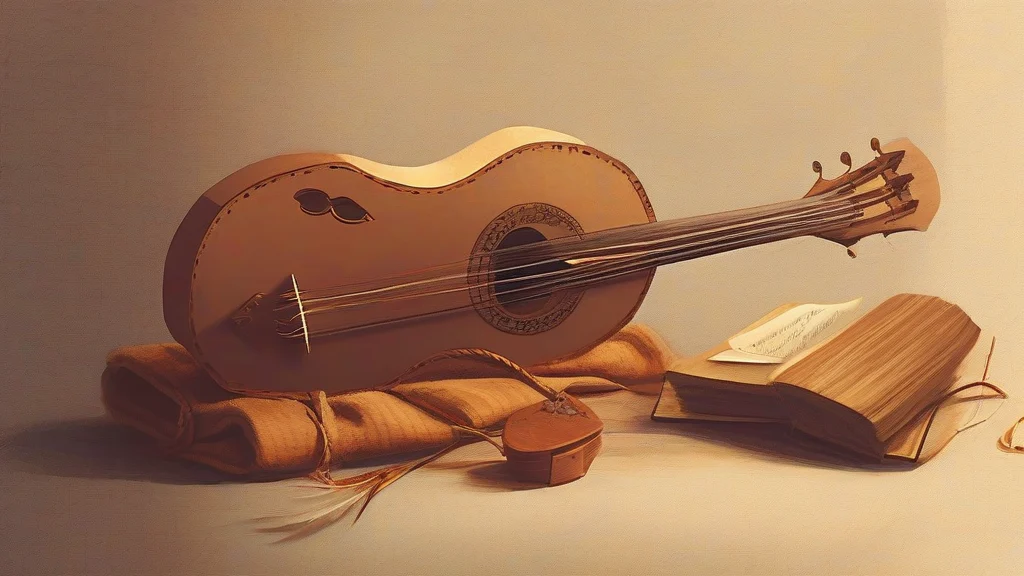
What does citole mean?
The citole is a medieval stringed instrument that flourished in Europe roughly between the twelfth and fourteenth centuries. Typically featuring four strings and a flat-backed body, it was plucked with a quill or plectrum and appears frequently in medieval manuscripts, carvings, and illustrations, making it well known to scholars even though no widely accepted original examples survive in playable condition. Its most distinctive feature was often a hole cut through the neck for the player's thumb, an unusual design element that helps musicologists distinguish depictions of the citole from those of related instruments such as the gittern. The citole is considered a precursor of the Renaissance cittern, and tracing its lineage illuminates the development of the modern guitar family. Today the word survives mainly in academic contexts — musicology, medieval literature, and early-music performance — where it names both a historical instrument and, in some cases, modern reconstructions built by instrument makers specializing in medieval repertoire.
nounA medieval stringed musical instrument, typically with four strings and a flat back, played with a quill or plectrum; a predecessor of the cittern.
- A medieval plucked stringed instrument with four strings and a flat body, played with a plectrum, common in Europe between the 12th and 14th centuries.
"The troubadour strummed his citole as he sang of courtly love."
"The minstrel's citole hung from his belt as he wandered from castle to castle."
"Museum curators carefully preserved the sole surviving citole, a treasure of medieval musicology."
Regular plural formation; used when referring to multiple instruments or multiple depictions in art.
"The exhibition displayed reconstructions of several medieval citoles."
The citole had a hole in its neck for the player's thumb — one of the strangest designs in the history of instruments.
Reviewed by Deb Chak, Editor. AI-assisted content curated by RJS Tech Solutions LLP.
Etymology of citole
The word citole entered English in the Middle English period through Old French, where it appeared as forms such as 'citole' or 'cytolle'. It ultimately derives from Latin 'cithara', itself borrowed from Greek 'kithara', the ancient lyre-like instrument whose name also gave rise to 'guitar', 'zither', and 'cittern'. The word fell largely out of use after the Middle Ages and was revived by modern scholarship to label the instrument depicted in medieval art.
How citole is actually used
Citole is a specialized term used almost exclusively in musicology, medieval studies, and discussions of early music. It is rare in everyday speech.
Easily confused with citole
The citole is an earlier four-stringed medieval instrument with a distinctive thumb-hole neck, while the cittern is a later Renaissance instrument with a pear-shaped body and more strings.