
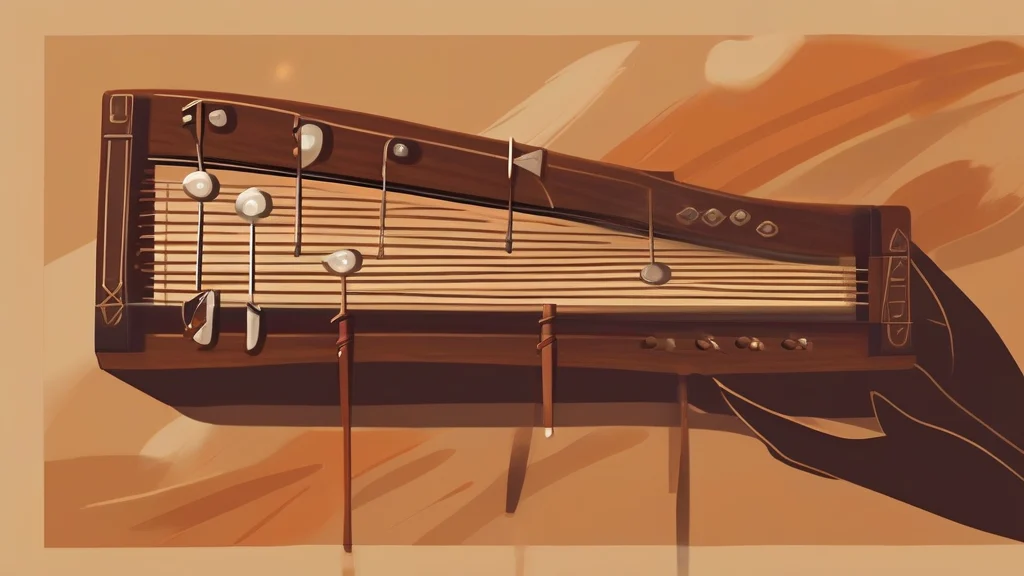
What does zither mean?
The zither is a plucked musical instrument whose strings are stretched across a flat soundboard, usually while the instrument lies horizontally or is held upright. Players pluck or strum the strings with their fingers or with small plectrums, and many modern zithers include fretted fingerboards that support melody playing. In ordinary English, the word most often refers to the concert zither associated particularly with German and Austrian folk and classical traditions, although related plucked instruments have long histories in many cultures. “Zither” is a specialized but useful name because it distinguishes a specific instrument family from related terms such as dulcimer and psaltery, which may refer to other constructions or broader categories. Its appearance in descriptions of folk music, chamber performances, and historical instruments gives it a sense of both tradition and craftsmanship. The word also has an unusually international history: it entered English from German, whose name was borrowed from ancient Greek. As a result, zither is concise and familiar while pointing back to a much older European tradition of stringed musical instruments.
nounA musical instrument with strings stretched over a flat soundboard, played by plucking or strumming the strings with the fingers or a plectrum.
- A plucked string instrument whose strings are stretched across a flat soundboard and played with the fingers or a plectrum.
"The musician played a delicate melody on the zither as the orchestra accompanied her."
"A zither accompanied the singer with a warm, gently rippling melody."
"The museum display included an antique concert zither with many strings and frets."
The plural is used when referring to more than one zither instrument.
"The musicians carried two zithers to the outdoor performance."
Its name travels remarkably far: English borrowed the word from German, which borrowed it from ancient Greek.
Reviewed by Deb Chak, Editor. AI-assisted content curated by RJS Tech Solutions LLP.
Where does zither come from?
Modern English borrowed the word from German Zither in the early nineteenth century. The German term ultimately derives from ancient Greek kithara, the name of a historical stringed instrument. The same Greek source also lies behind Latin cithara and, through later borrowing and development, words such as cittern, citole, and guitar.
How zither is actually used
This is a neutral, specialized musical term rather than everyday vocabulary. In modern English it most often denotes the fretted concert zither associated with German-speaking musical traditions, though it may also refer more broadly to related flat-board string instruments.
Easily confused with zither
A zither has plucked strings stretched over a flat soundboard, whereas a cittern is a pear-shaped stringed instrument that is commonly bowed or plucked.