
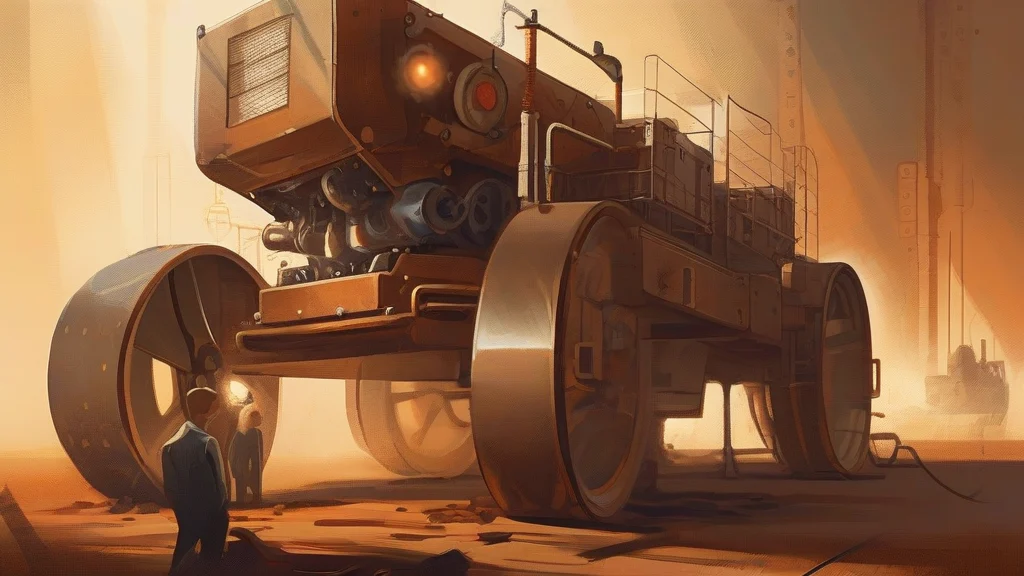
What does mechanizing mean?
Mechanizing is the present participle of mechanize, meaning to introduce machinery or mechanical methods into a process so that it can be carried out more efficiently or automatically. It is especially common in discussions of industrial production, agriculture, transportation, and office administration: factories mechanize manufacturing, farms mechanize cultivation, and organizations mechanize repetitive administrative work. The word can also suggest that a process is becoming standardized, uniform, or impersonal. Its meaning is broader than merely adding equipment, because the emphasis is on changing the underlying method of operation. In contemporary usage, “automate” is often the more precise alternative when software or electronic control is central. Mechanizing nevertheless remains useful for describing the large-scale transition from manual or traditional methods to machine-based production, while its historical roots connect it closely with the development of industrial societies.
verbTo convert a process, system, or form of work to operation by machines or mechanical methods, often making it more automatic and efficient. It can also mean to make something mechanical or systematic.
- To convert work or a process to operation by machines or mechanical methods.
- To make an activity more systematic, uniform, or machine-like.
"The factory began mechanizing its production line, reducing the time required to assemble each component."
"Modern agriculture has mechanized many of the most demanding tasks, from planting to harvesting."
"The company is mechanizing its approval process so that routine requests can be handled automatically."
"By mechanizing repetitive work, the organization hopes to allow employees to focus on more creative responsibilities."
Mechanizing tells the story of societies moving from handwork to machine production, while preserving the literal idea of a machine in its Greek roots.
Reviewed by Deb Chak, Editor. AI-assisted content curated by RJS Tech Solutions LLP.
Where does mechanizing come from?
Mechanizing derives from mechanize, which was formed from mechanism and the suffix -ize. Mechanism ultimately comes through French from Greek mēkhanē, meaning “machine,” “device,” or “contrivance,” a term associated with craft and mechanical ingenuity. Related English words such as machinery, mechanic, and mechanical preserve the same broad etymological connection with machines and organized mechanical processes.
Related word forms
How mechanizing is actually used
Mechanizing is formal and commonly describes industrial, agricultural, or administrative processes. It is transitive and usually takes a process, system, or area of work as its object, as in “mechanize production.” In some contexts, it can imply making work rigidly systematic rather than simply introducing machinery.
Easily confused with mechanizing
Mechanize generally emphasizes equipping work with machinery or mechanical methods, whereas automate often emphasizes controlling a process with automatic equipment or software.
Mechanizing is the verb describing the act or process of introducing machinery, while mechanization is the resulting process or system.