
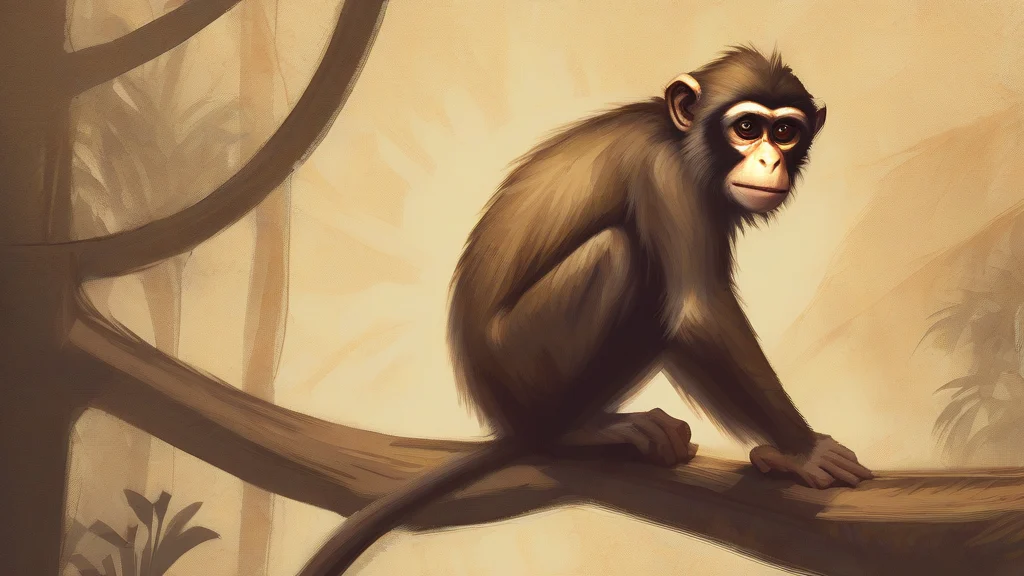
What does monkey mean?
A monkey is a primate found mainly in Africa and Asia, recognizable by features such as a long tail, grasping hands, and a forward-facing face. In everyday conversation, the word can also describe a mischievous, cheeky, or foolish person, though this use may sound insulting or teasing depending on context. As a verb, 'monkey' means to interfere with or tamper with something, as in 'someone is monkeying with the settings.' The word has an interesting history: its precise origin is uncertain, but it was already established in English by the medieval period. Today, 'monkey' appears in both literal animal descriptions and idiomatic expressions such as 'monkey business,' 'monkey around,' and 'monkey with.' It is also used in compounds referring to objects, tools, and activities, including the monkey wrench and monkey bars. The term is familiar and vivid, making it especially effective when describing restless, playful, or meddlesome behavior.
A primate of the family Cercopithecidae, found mainly in Africa and Asia, typically with a long tail, grasping hands, and a forward-facing face. Informally, it can also refer to a mischievous or foolish person.
"The zoo's monkeys entertained the crowd with their acrobatic movements."
The figurative sense is informal and may be teasing or insulting depending on context.
To interfere with, tamper with, or handle something in a meddlesome or playful way.
"Someone has been monkeying with the lock again."
Informal; especially common in the expressions 'monkey with' and 'monkey around'.
The regular plural is 'monkeys'; the plural is used for multiple animals and, informally, for multiple mischievous people.
"The monkeys raided the picnic basket while the campers were asleep."
Some monkeys use tools, including sticks for extracting insects and stones for cracking open hard food.
Reviewed by Deb Chak, Editor. AI-assisted content curated by RJS Tech Solutions LLP.
Where does monkey come from?
The word comes from Middle English monke, a form recorded from the medieval period. Its exact origin is uncertain; it may have entered English through Old French and Medieval Latin, whose further derivations are debated. The modern sense referring to a mischievous person developed later by analogy with the animal's lively and playful behavior.
Related word forms
How monkey is actually used
The animal sense is standard in British and US English. The senses referring to a mischievous or foolish person are informal and may be insulting depending on tone. As a verb, 'monkey' is informal and commonly appears in 'monkey with' and 'monkey around'.
Easily confused with monkey
An ape is a primate without a tail, while monkeys generally have tails; the terms also differ in how precisely they distinguish among primate groups.
A donkey is a domesticated horse, whereas a monkey is a primate; the words also rhyme but are unrelated in meaning.