
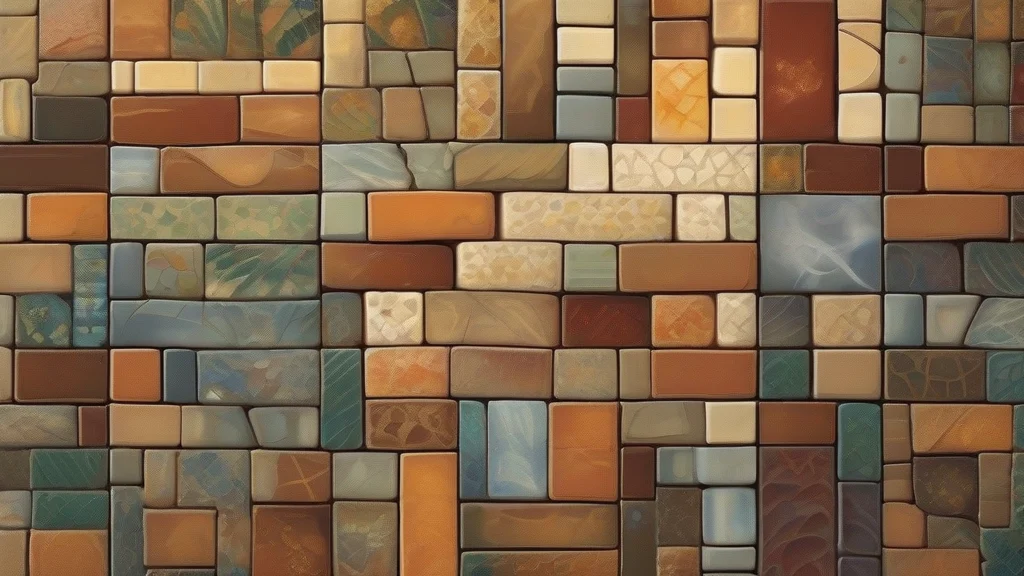
What does mosaics mean?
Mosaics are designs or artworks made by fitting together many small pieces of colored material, such as stone, glass, ceramic, or tile. They may form pictures, geometric patterns, or decorative surfaces on walls, floors, ceilings, and objects. The individual pieces are often called tesserae, although that term more specifically refers to pieces used in the traditional mosaic technique. Mosaics are especially associated with ancient Roman and Byzantine art, where elaborate floor and wall designs could be assembled with extraordinary precision. Today, the word is also used broadly for contemporary decorative art and architectural decoration. In general usage, “mosaics” can refer either to the pieces themselves or to the completed designs. The word has a rich artistic and historical association, making it useful when describing both individual artworks and collections of decorative work.
noun (plural)Mosaics are small pieces of colored stone, glass, ceramic, or other material fitted together to form a decorative or pictorial design. The word can also refer to such a design as a whole, especially on a wall, floor, or other surface.
- A decorative or pictorial design made from small, usually colored, pieces of stone, glass, ceramic, or other material.
- The individual pieces used to make such a design, especially in a wall, floor, or object.
"The ancient Roman villa was decorated with mosaics depicting animals and geometric patterns."
"The museum preserves Roman mosaics that once decorated the floors of large villas."
"She designed a striking mosaic of blue and gold tiles for the entrance hall."
The standard plural of the singular noun “mosaic.”
"The archive contains photographs of Roman mosaics from several villas."
From Greek ideas associated with the Muses, the word once described a place where the arts were gathered; today it names a picture assembled from thousands of tiny pieces.
Reviewed by Deb Chak, Editor. AI-assisted content curated by RJS Tech Solutions LLP.
Where does mosaics come from?
The word comes through Medieval Latin from the Latin adjective mosaicus, which was derived from the Greek mousaion, meaning a place associated with the Muses. The Greek term referred originally to a place where the arts were practiced, and the Latin word was later applied to work made from small pieces of stone or glass. English borrowed the singular form in the 16th century, and “mosaic” subsequently became a noun, adjective, and verb.
Related word forms
How mosaics is actually used
The plural is usual when referring to a collection or a group of individual pieces. In artistic and archaeological contexts, the term is commonly associated with Roman, Byzantine, and Islamic decorative traditions, though it is used much more widely.
Easily confused with mosaics
A mosaic is the design or artwork made from many small pieces, while mosaics usually refers to those pieces collectively or to multiple such artworks.