
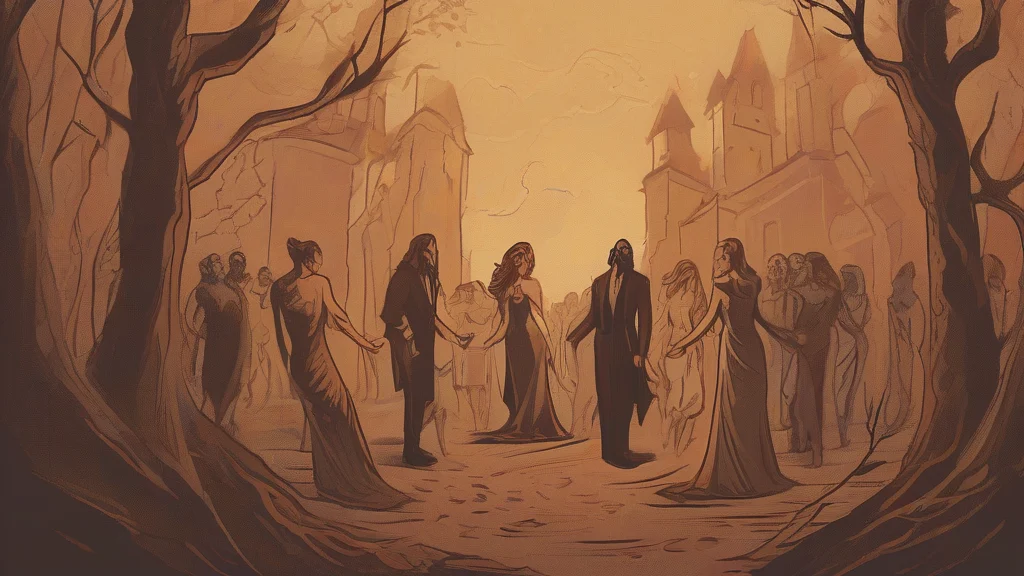
What does orgia mean?
Orgia is an uncommon plural noun for wild, ecstatic, or licentious revelries, often with associations of secret ceremonies, intoxication, and uninhibited celebration. Its dominant sense refers to communal festivities that depart from ordinary restraint, although it can also describe gatherings marked by intense religious or sexual excitement. The word is most common in historical and literary writing, where it evokes ancient pagan rites and provides a classically flavoured alternative to the ordinary plural “orgies.” Its own plural form gives it a distinctive appearance: unlike a regular English noun, “orgia” normally appears in the plural, while the singular is “orgy.” Modern speakers are more likely to encounter “orgy” or “orgies” in general use, but “orgia” can be effective when emphasizing ceremony, antiquity, secrecy, or a deliberately elevated tone.
noun (plural)A plural noun denoting wild or orgiastic revelries, especially licentious celebrations held in secret. It is now chiefly literary and historical, with “orgies” being the more usual modern plural of “orgy.”
- Wild, licentious revelries or celebrations, especially secret nocturnal ceremonies.
- Orgastic or ecstatic celebrations characterized by intense, uninhibited excitement.
"The nocturnal orgia continued until the first light of morning."
"The priestess led the orgia with music, dance, and wine."
"Accounts of the orgia describe rites performed under cover of darkness."
“Orgia” is itself normally plural; its singular is “orgy,” and “orgies” is the more usual modern plural.
"The records mention several orgia held at the sanctuary."
The word “orgia” carries its plural in the form itself, recalling the secretive revelries of ancient religious rites.
Reviewed by Deb Chak, Editor. AI-assisted content curated by RJS Tech Solutions LLP.
Where does orgia come from?
The word comes from ancient Greek ὄργια (orgia), a plural form associated with rites, observances, and secret ceremonies; the related Greek singular ὄργος (orgos) denoted a rite or celebration. Latin also used orgia in the plural, and English borrowed the term in connection with Bacchic and other ecstatic religious practices. The form “orgia” therefore preserves an inherent plural, while the now more familiar singular “orgy” and plural “orgies” reflect the word’s later development in English.
Related word forms
How orgia is actually used
Chiefly literary, historical, or antiquarian. In contemporary English, “orgies” is more usual, and the singular “orgy” is the standard form used in phrases such as “a pagan orgy” or “a drunken orgy.”
Easily confused with orgia
“Orgy” is the usual singular noun, while “orgia” is a plural form and “orgies” is the more common modern plural.