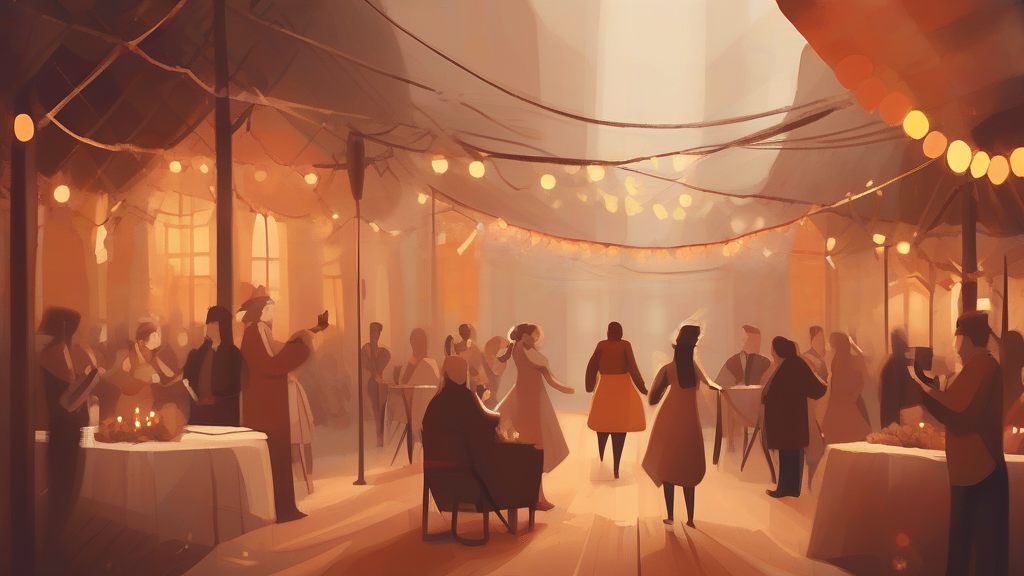
What does festivity mean?
Festivity denotes joyful celebration and merry-making, whether as a concrete round of events or as the buoyant atmosphere that pervades them. The word most often appears in contexts of holidays, weddings, national occasions, and public gatherings, frequently in the plural form 'the festivities' to describe a sequence of celebratory happenings. To speak of 'an air of festivity' is to capture something intangible yet instantly recognizable: decorations, laughter, music, and shared good humor. The term carries a warm, positive connotation and leans slightly literary or formal, making it a favorite of journalists and novelists describing grand occasions. It derives from Latin festivus, meaning joyous or merry, the same root behind 'festive' and 'festival,' which keeps the family of words firmly anchored in humanity's oldest impulse — gathering together to celebrate.
Cheerful merrymaking or celebration; the enjoyment associated with a festive occasion.
"The palace opened its gardens for a week of royal festivities."
Commonly used in the plural to refer collectively to celebratory events.
A festive mood or atmosphere of gaiety and rejoicing.
"An air of quiet festivity filled the candlelit hall."
The plural is very common and often preferred when referring to a set or series of celebratory events, as in 'the holiday festivities.'
"The anniversary festivities began with a parade and ended with fireworks."
Every Christmas carol and New Year's party owes its spirit to a single Latin word: festivus, meaning 'joyous' — the same root that gave us 'festival' and even the tongue-in-cheek holiday 'Festivus.'
Reviewed by Deb Chak, Editor. AI-assisted content curated by RJS Tech Solutions LLP.
Etymology of festivity
Festivity comes from the Latin festivitas, formed from festivus, meaning 'joyous, festive, or suitable for a feast,' which itself derives from festum, a feast or holiday. English borrowed the word in the early modern period, with senses covering both merrymaking and a festive disposition. Its Latin root also gave English 'festival,' 'festive,' and, via Spanish influence, 'fiesta.'
How festivity is actually used
Often used in the plural ('the festivities') to refer to a series of celebratory events. Slightly formal or literary in register compared with everyday words like 'party' or 'fun,' but common in descriptions of holidays and public celebrations.
Easily confused with festivity
A festival is a specific organized event or occasion of celebration, while festivity is the abstract quality or activity of celebration itself.