
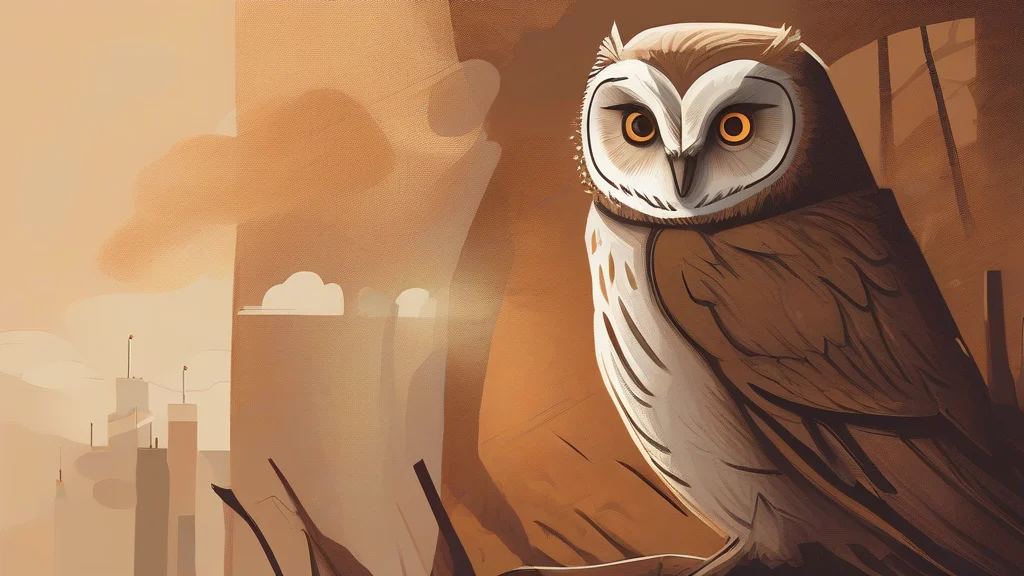
What does owlishly mean?
Owlishly is an adverb meaning in a manner that resembles an owl. It is used for someone who looks or behaves with unusual solemnity, often as if they possess grave wisdom or are carefully assessing a situation. The word can be admiring when it describes a thoughtful, perceptive appearance, but it is frequently gently humorous when applied to someone who seems stern, excessively serious, or professorial. Its vivid image comes from the owl’s fixed stare and traditional association with wisdom. In ordinary conversation, owlishly is more noticeable than a neutral manner adverb such as “seriously”; it highlights a conspicuous quality rather than simply describing seriousness. Typical expressions include “stare owlishly” and “look owlishly,” while related forms include the adjective “owlish” and the noun “owlishness.”
adverbIn an owl-like manner, especially with a solemn, serious, or professedly wise expression.
- In a manner resembling an owl, especially by looking serious, solemn, or wise.
"The professor regarded the question owlishly over the top of his glasses."
"She turned toward the speaker owlishly, as if weighing every word."
"The portrait depicts the statesman staring owlishly into the middle distance."
To look owlishly is to borrow the owl’s famous image of solemn wisdom—even if the wisdom is mostly theatrical.
Reviewed by Deb Chak, Editor. AI-assisted content curated by RJS Tech Solutions LLP.
Etymology of owlishly
The word is formed from “owlish,” an adjective meaning owl-like, with the adverbial suffix “-ly.” “Owl” comes from Old English “ūle,” which referred to the bird and was also used in compound expressions for someone regarded as wise or unpleasant to approach. Modern “owlish” developed in the nineteenth century, combining the bird’s appearance with its symbolic associations with wisdom and solemnity.
Related word forms
How owlishly is actually used
The adverb is somewhat literary and often humorous, particularly when describing a deliberately stern or professorial expression.
Easily confused with owlishly
Owlish is the adjective describing an owl-like appearance or manner, while owlishly is the adverb describing how an action or manner is performed.